Chem Cash.
Reward. Engage. Motivate.
- Practice
- Assess
- Understand
- Reteach
One app for everything a chemistry teacher does, built around a class economy students actually want to earn in. They practice for points, their tests get graded in minutes, and one page shows you what every class understands.
Free for pilot teachers this school year.
The problem
Every app does one piece. None of them knows what your students understand.
Practice lives in one app, grades in another, points in a third.
Grading eats the evenings.
Nothing adds it up until the unit test does.
How it works
One app for the whole loop.
The class economy
Every step pays points. Students spend them in the store, at auctions, on song requests and in a stock market.
1 · Practice
22 chemistry games, Reactor class sprints, Chem Clash, Catalyst explanations and missions.
Every game pays points
2 · Assess
Flashpoint quizzes and locked-down assessments. Assay for handwritten tests, graded by AI and checked by you.
Flashpoint pays points
3 · Understand
One page per class: what it understands in each topic, and how much evidence says so.
Imported scores can pay out
4 · Reteach
Retake practice, printed or online, for the students who need it, and a mission or Catalyst on the topic.
Missions and Catalyst pay points
…and around again, every unit. When grading takes minutes instead of evenings, you can see what every class understands each week, and reteach before the test instead of after it.
The engine
An economy they can see and touch.
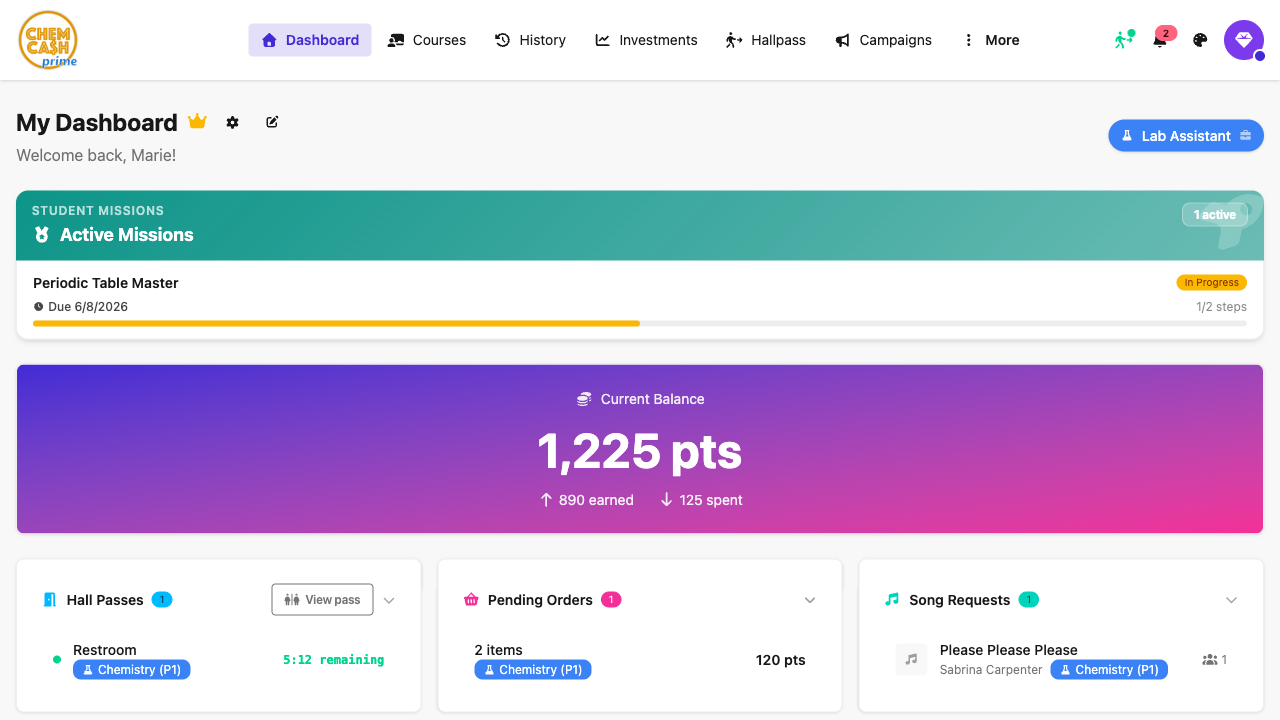
Every step of the loop pays into it. Students earn points, watch them grow, and spend them on things they actually want.
Points & Rewards
Every point
tells a story.
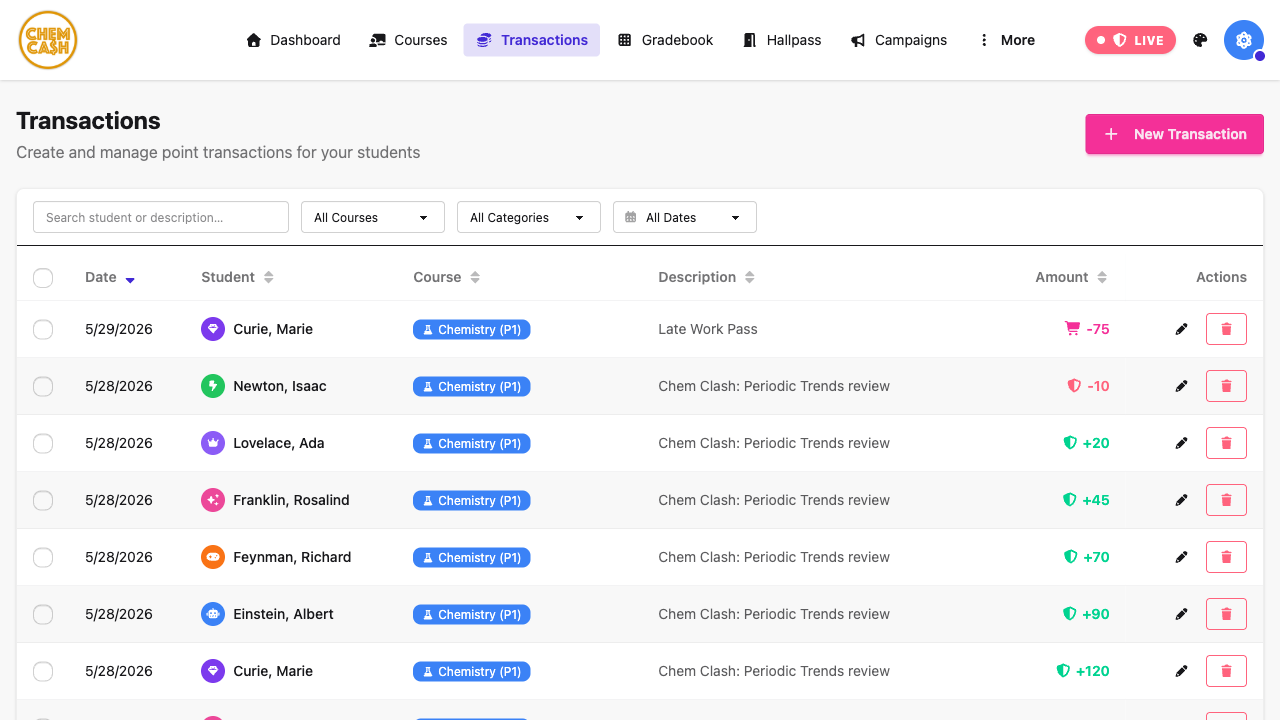
Post bonuses and fines in seconds. Import assignment scores from your grade book. Every transaction appears instantly on each student's dashboard.
- Award bonus points for outstanding work
- Post fines for late or missing items
- Import grades from a Canvas or Infinite Campus CSV export
- Custom score converters map any raw score to points
Class Store
A store they'll
actually want to visit.
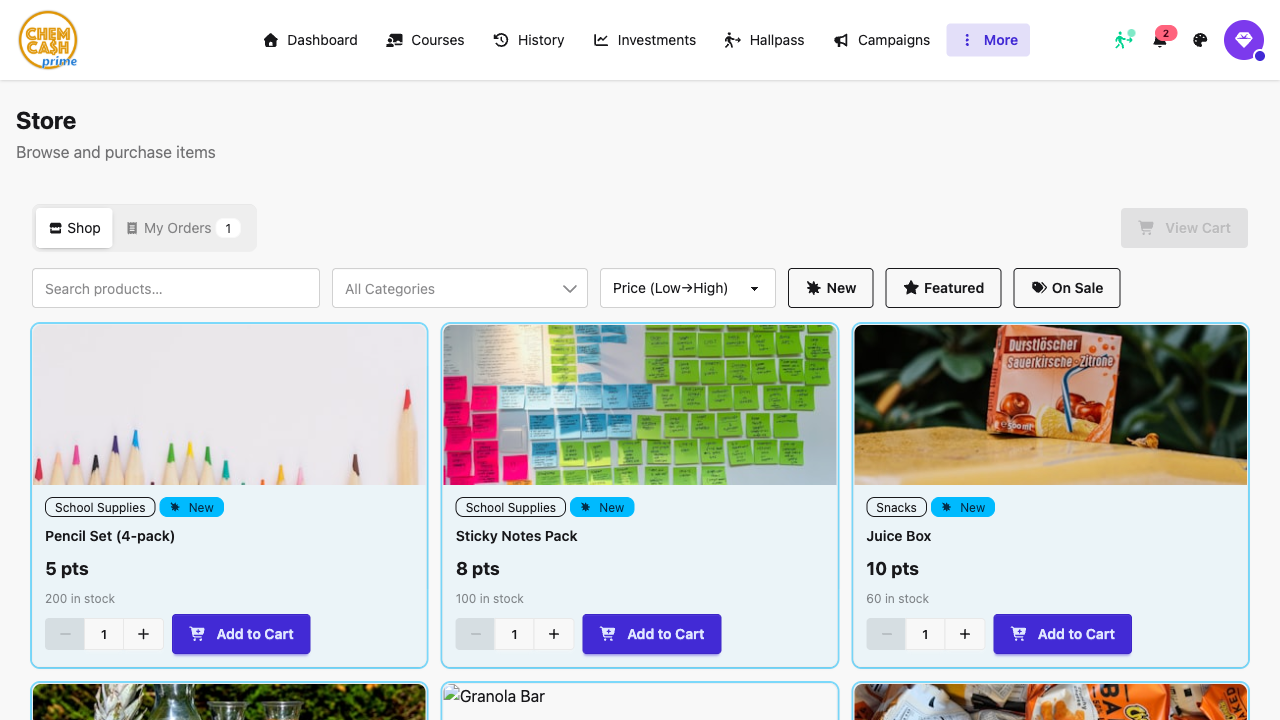
Build a virtual marketplace stocked with anything your students value. They earn, they shop, you approve. It's an economy they can see and touch.
- Create any product — homework passes, candy, privileges
- Students browse, add to cart, and check out with points
- One-click teacher approval for every order
- Real-time order queue — no paper slips needed
- Or auction off high-value rewards — students bid, top bidder wins
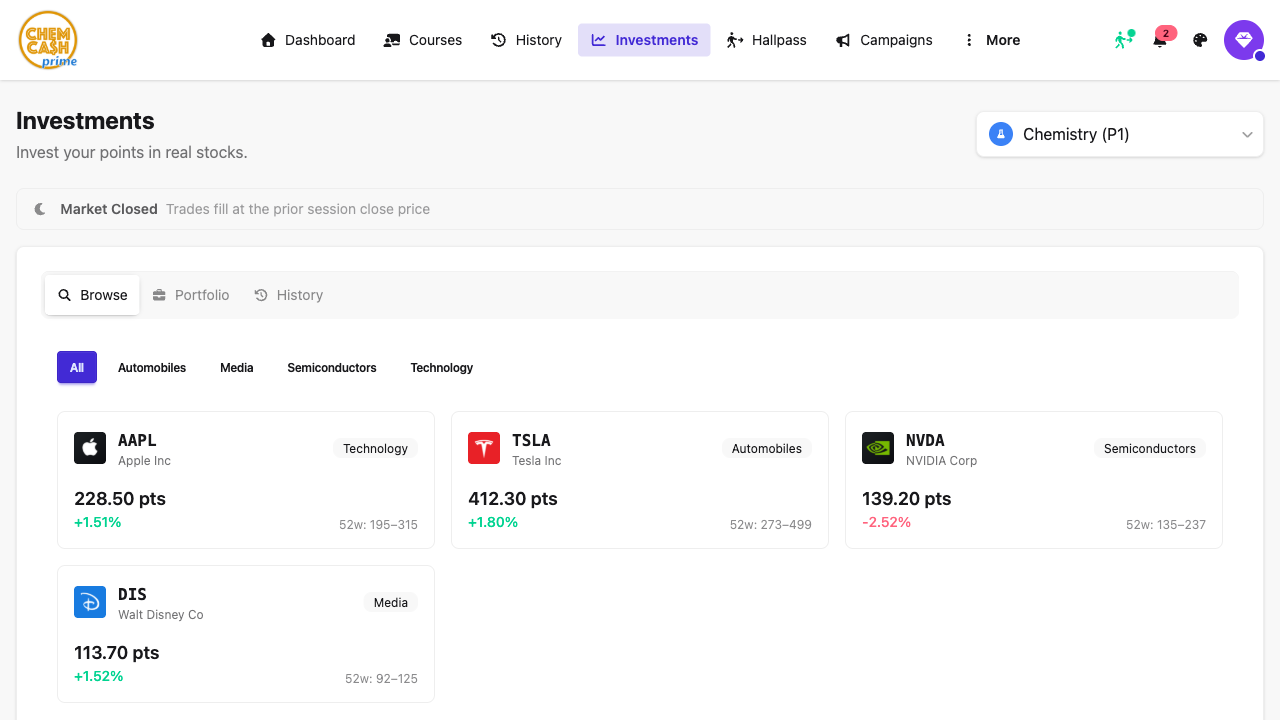
Investments
A stock-market simulation with real tickers and live prices. Students invest their points, ride the ups and downs, and learn how markets work — with no real money on the line.
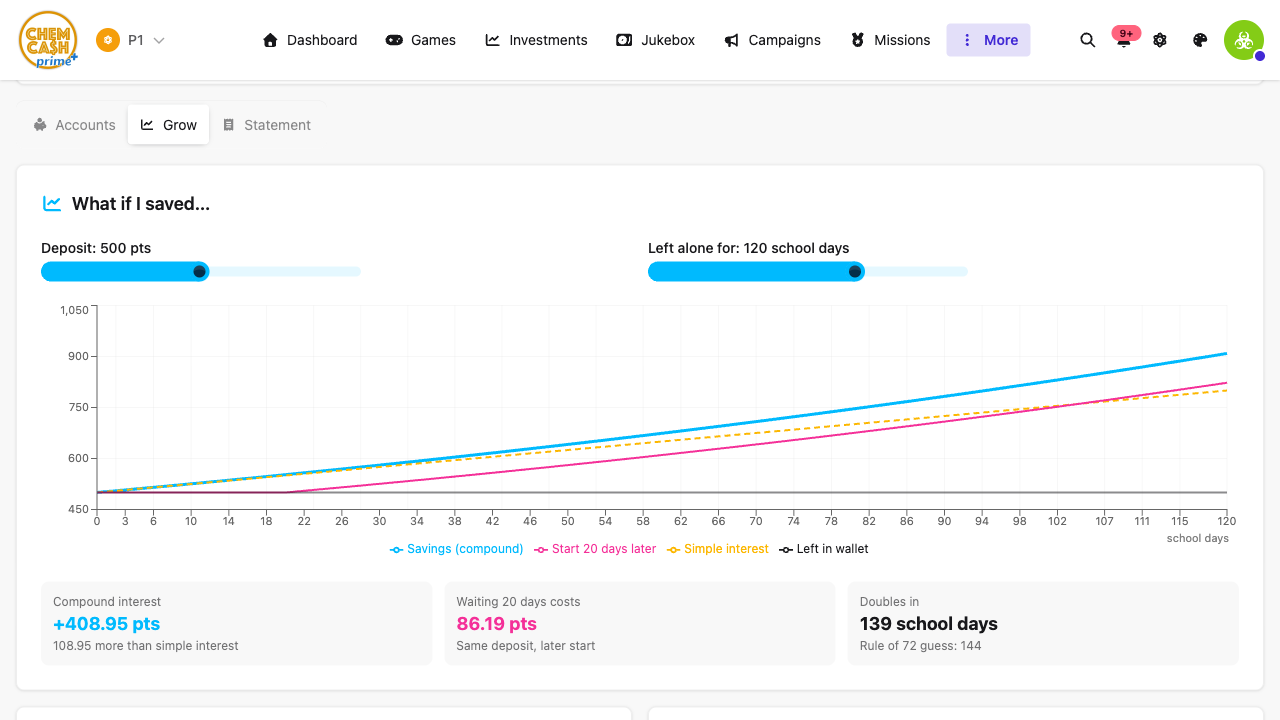
Savings Accounts
Students save points that earn compound interest every school day, set goals, and lock in CDs for a higher rate — then watch compounding pull away on a "what if" chart.
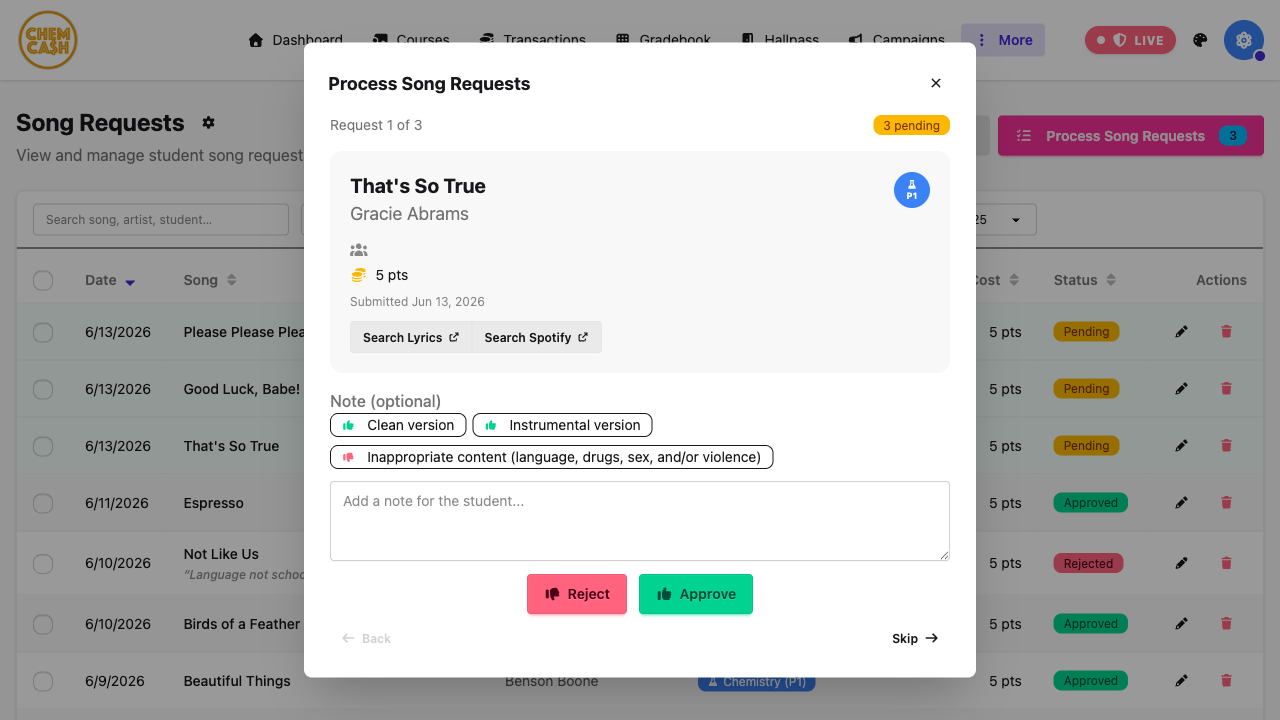
Song Requests
Students spend points to add songs to the class playlist. You set the price and approve or reject each one, with saved message presets to keep it quick.
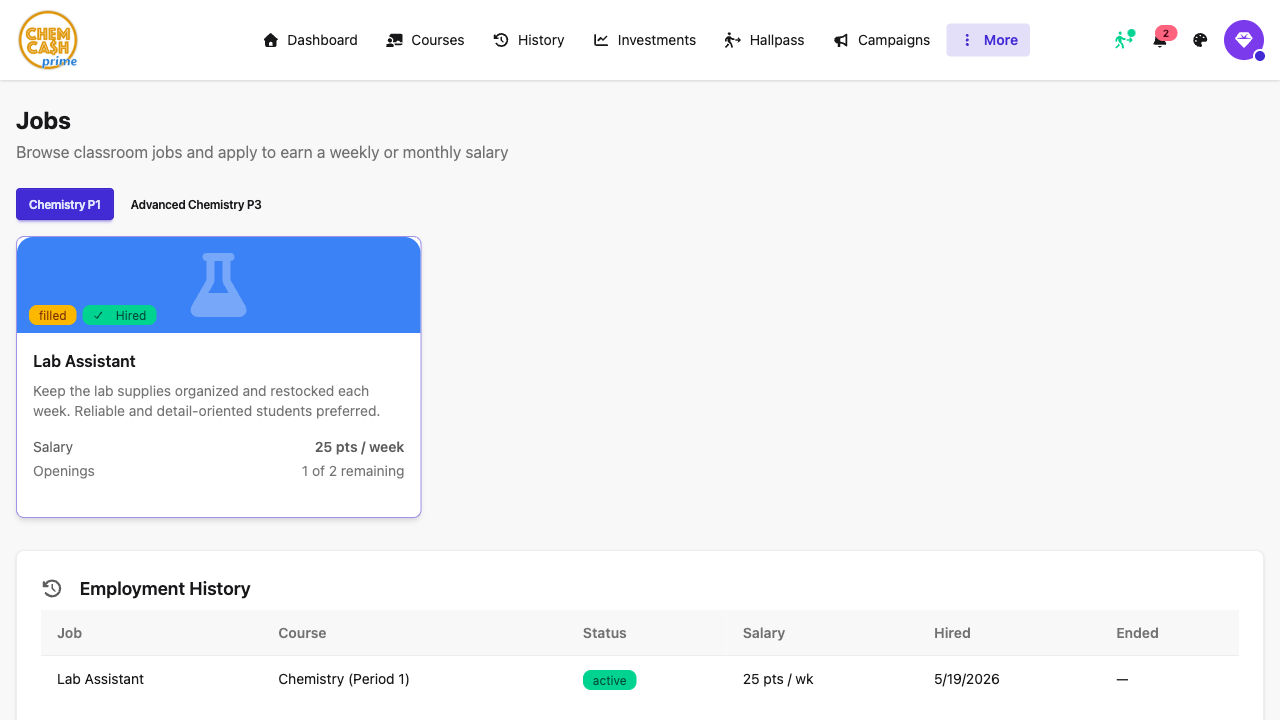
Classroom Jobs
Post recurring jobs that pay a salary in points. Students apply, you hire, and payouts run automatically every week or month.
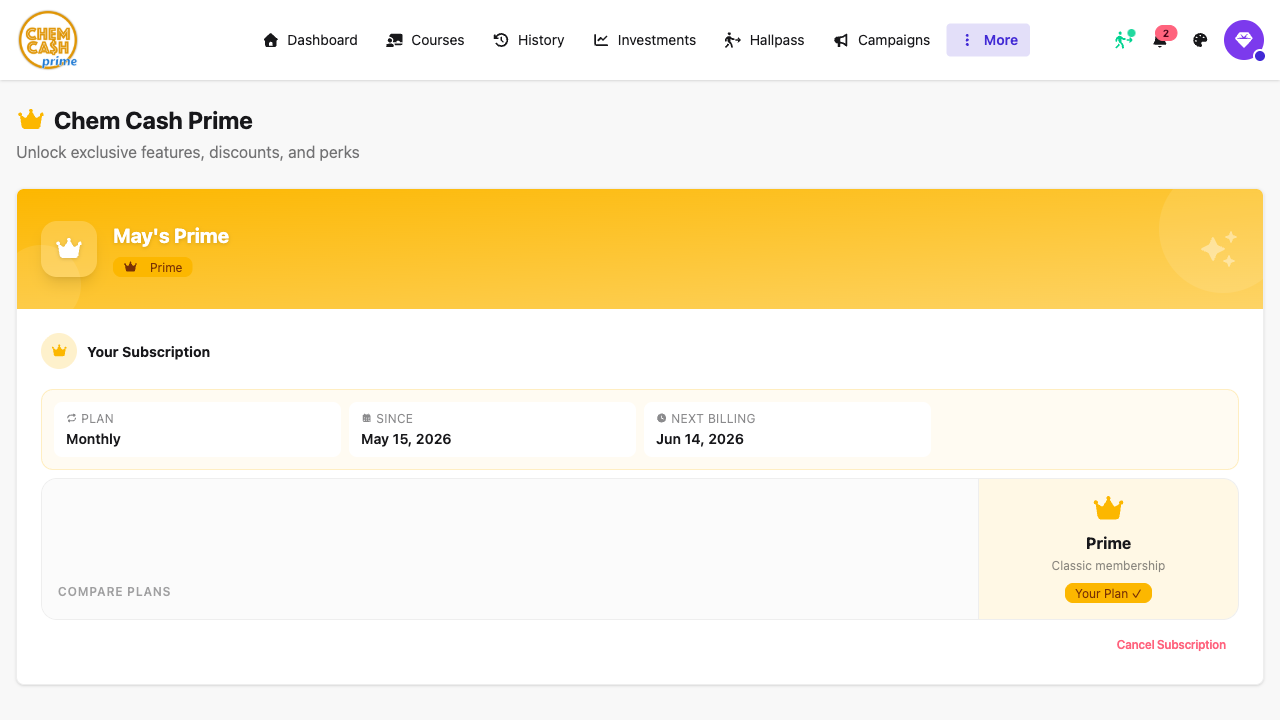
Prime Memberships
Let students subscribe with points to unlock perks like store discounts and bonus rewards. Prime and Prime Plus tiers included.
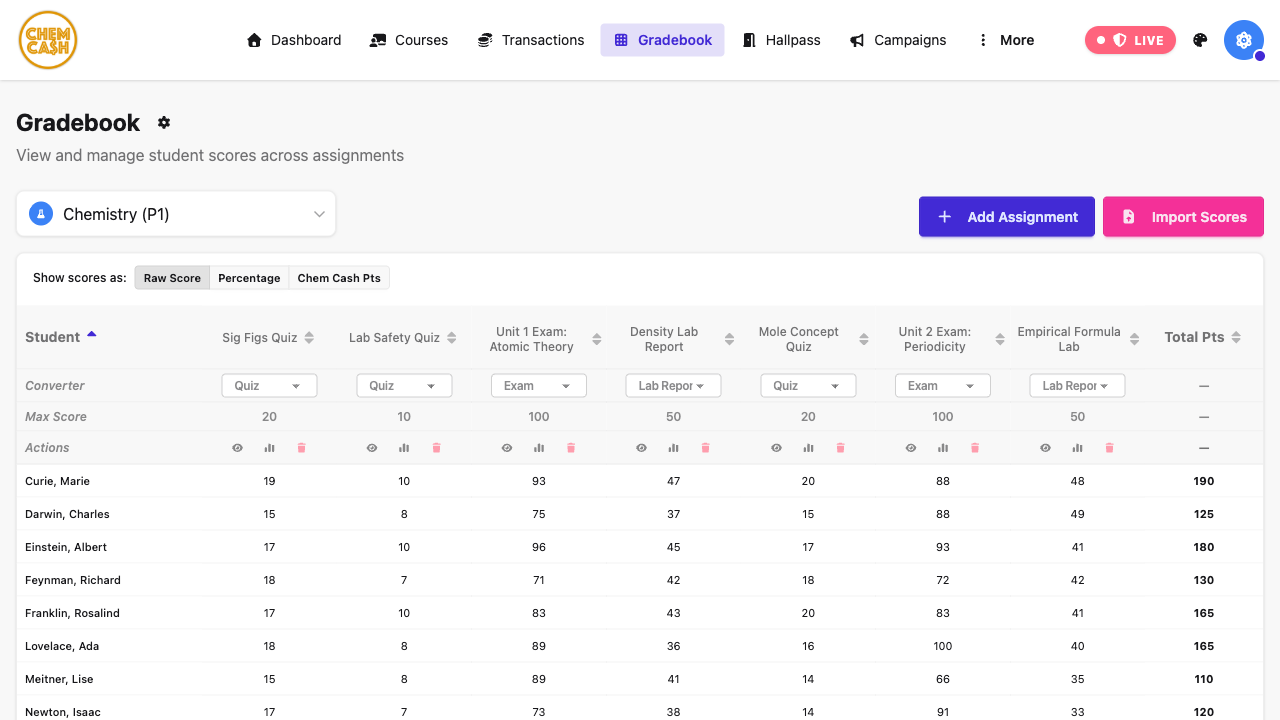
Gradebook Import
Export a grade CSV from Canvas or Infinite Campus, import it, and let custom score converters handle the math — points awarded automatically.
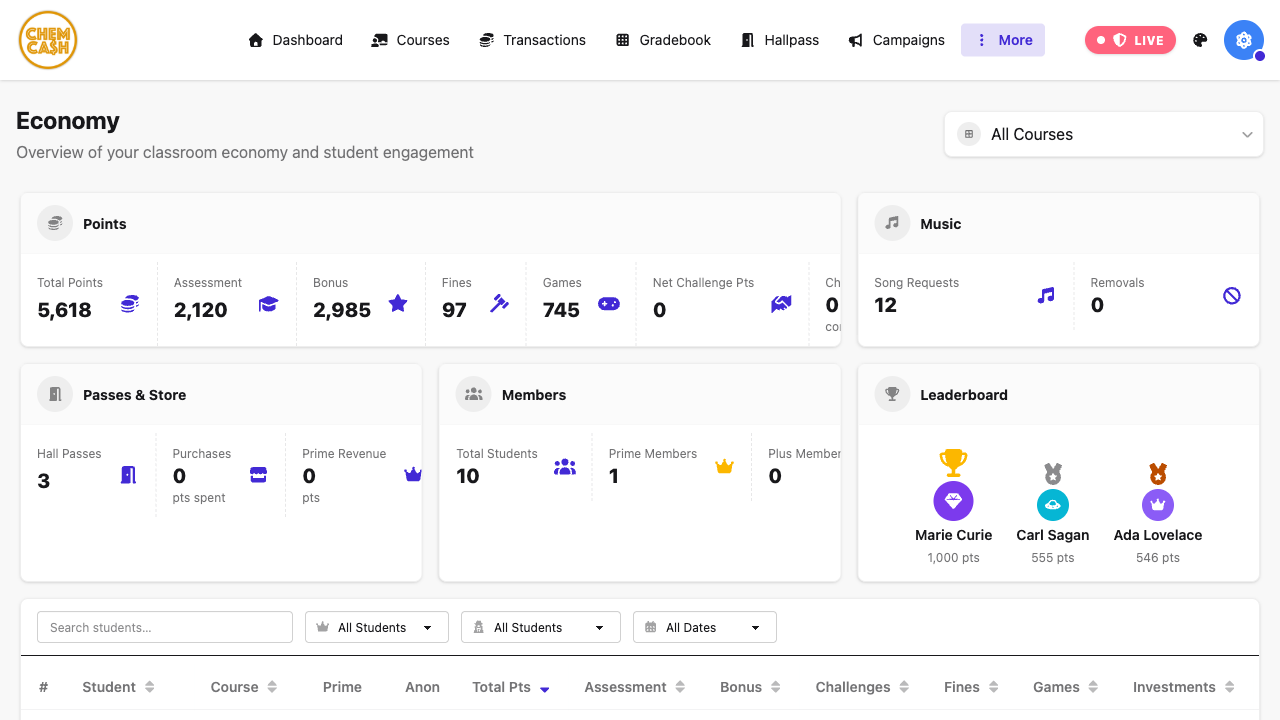
Economy Dashboard
See spending breakdowns and balance distributions across all your courses at a glance.
1 · Practice
The chemistry is the game.
22 chemistry games
· Every point spends in the class economy
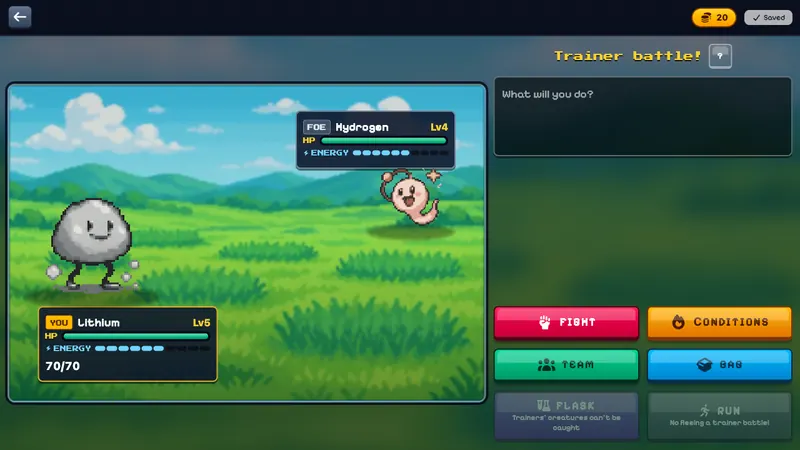
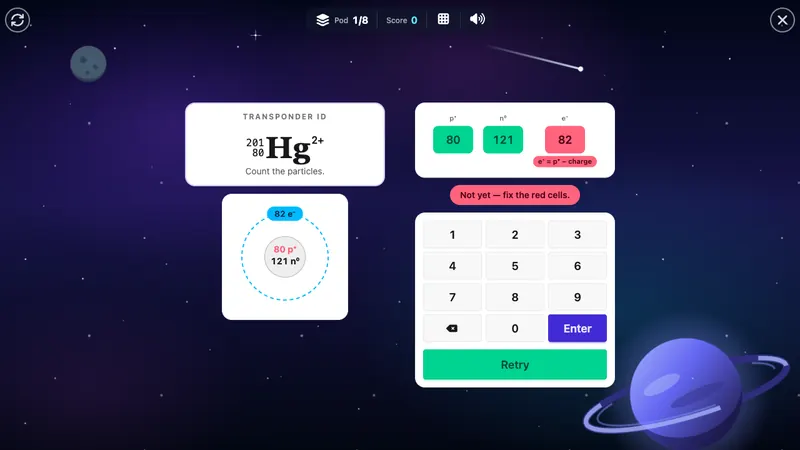
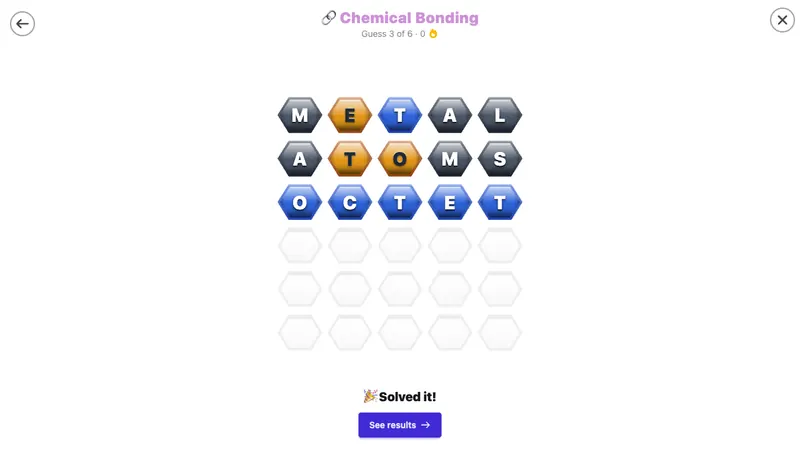
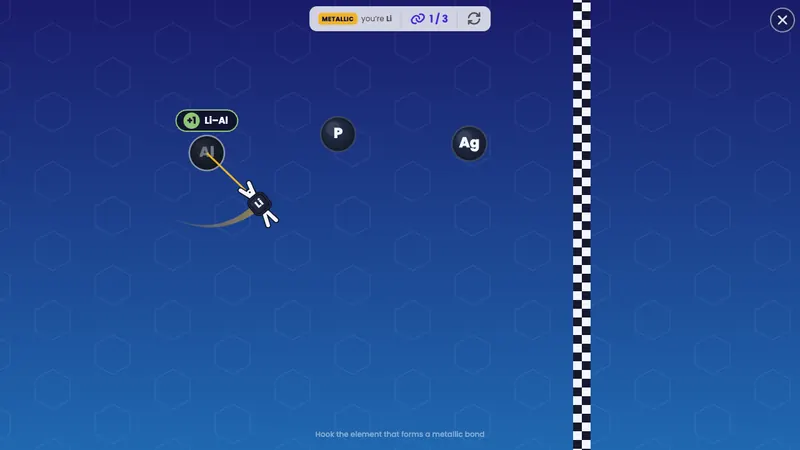
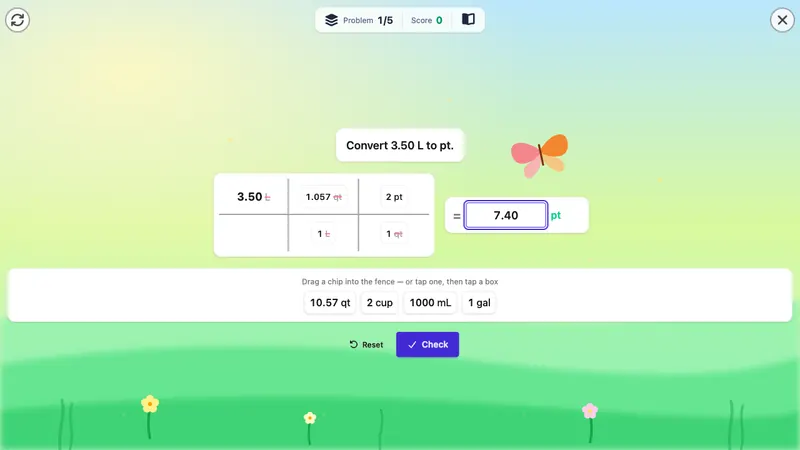
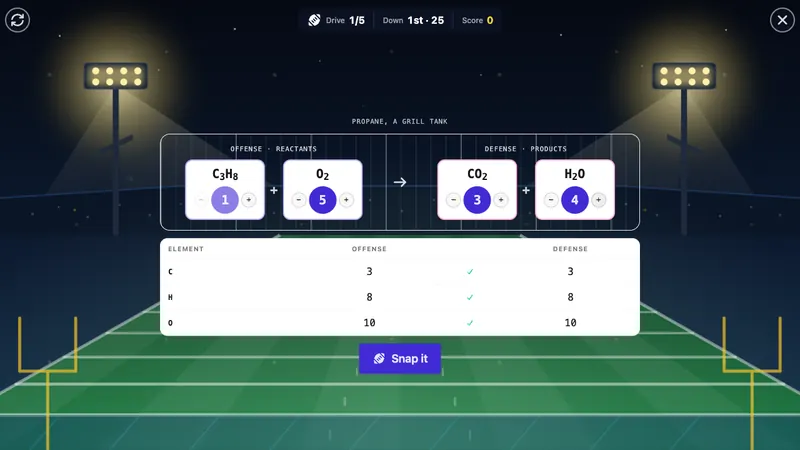
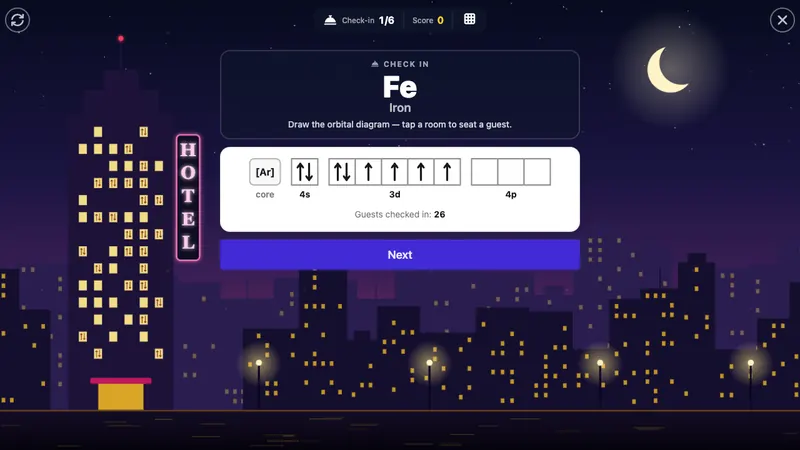
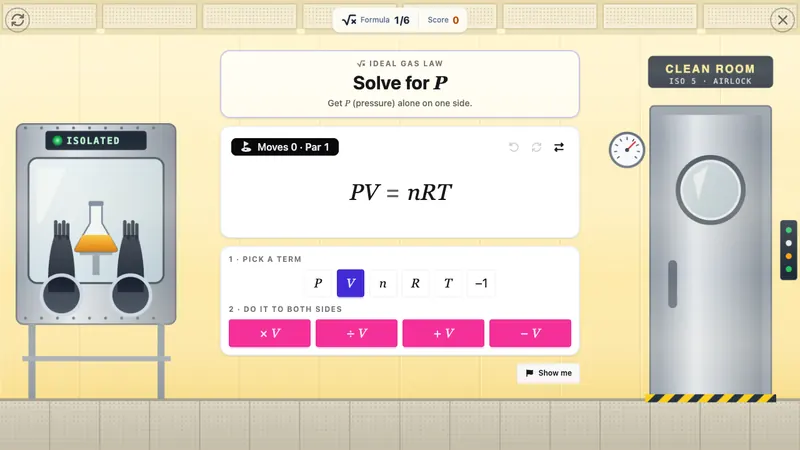
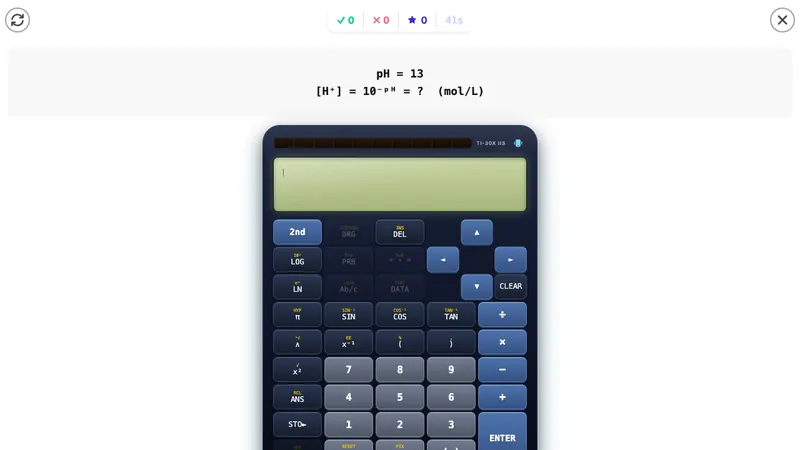
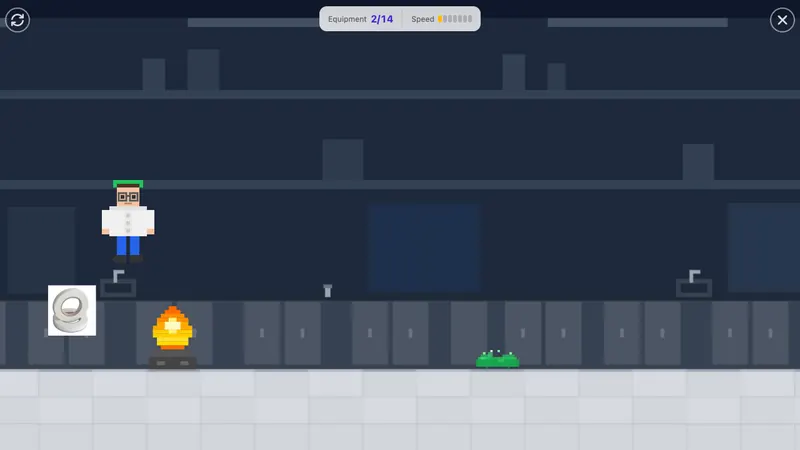
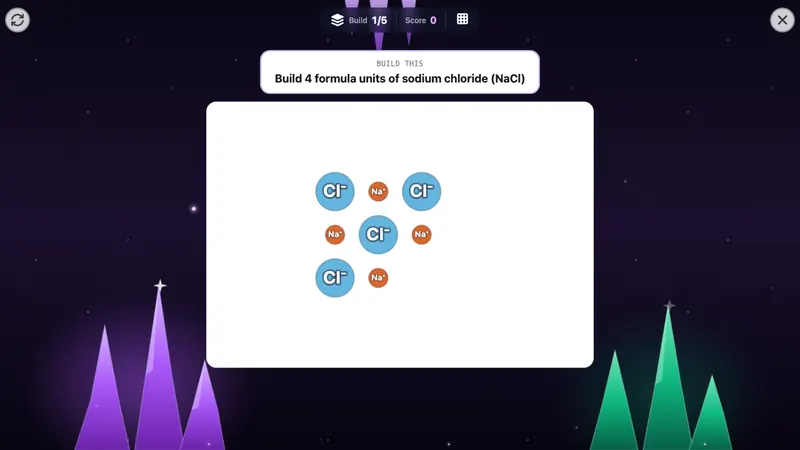
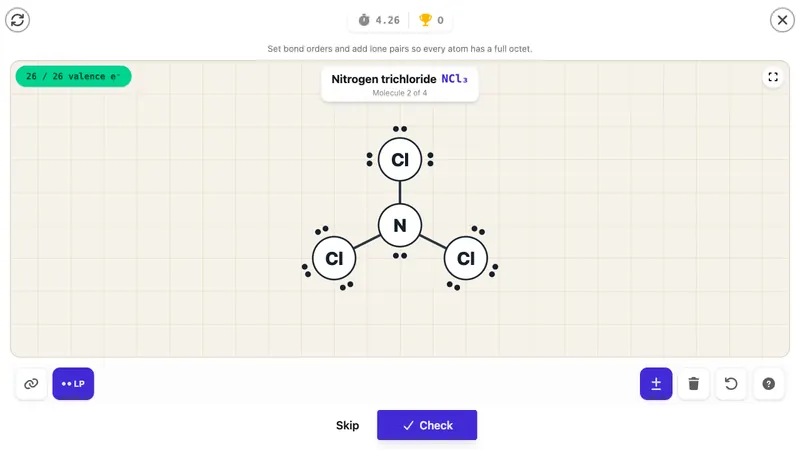
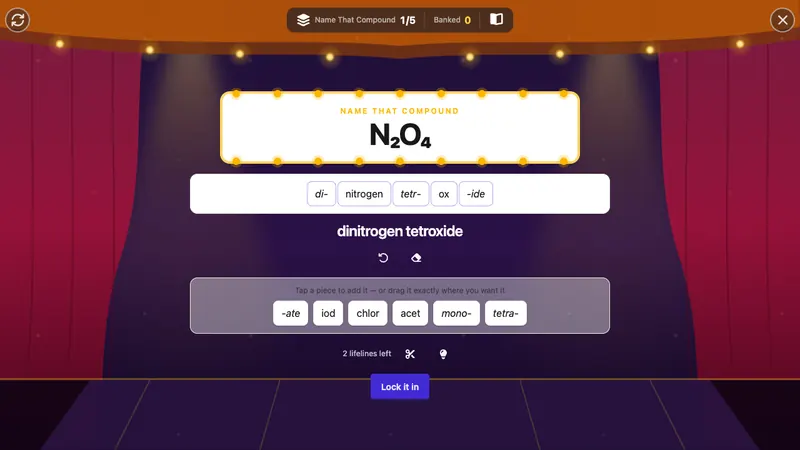
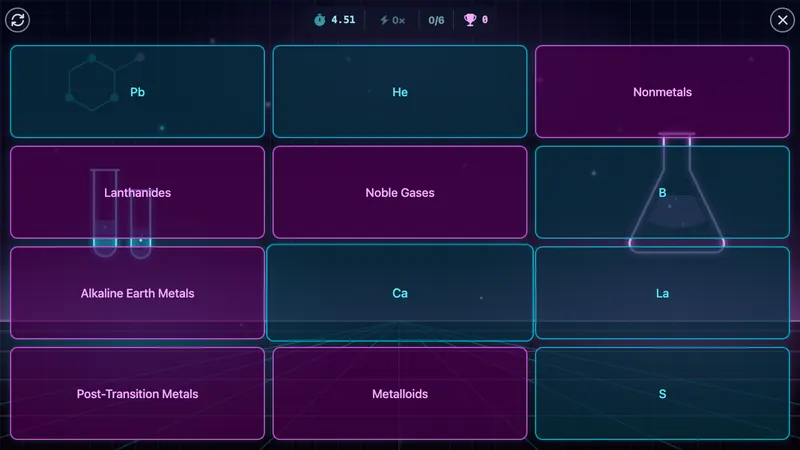
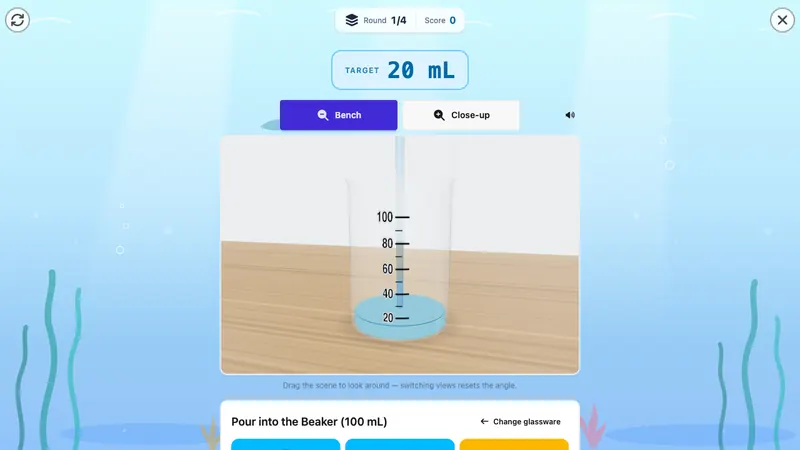
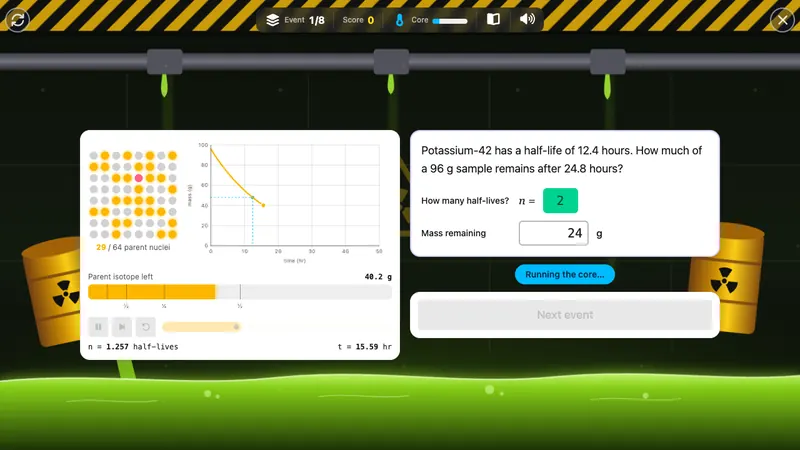
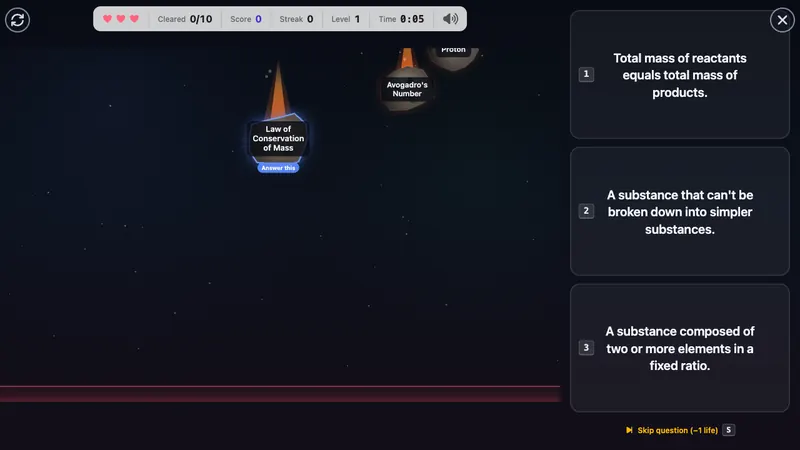
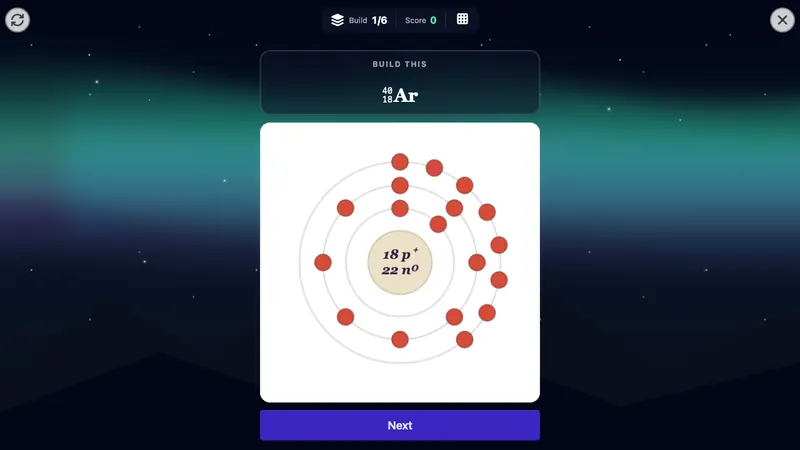
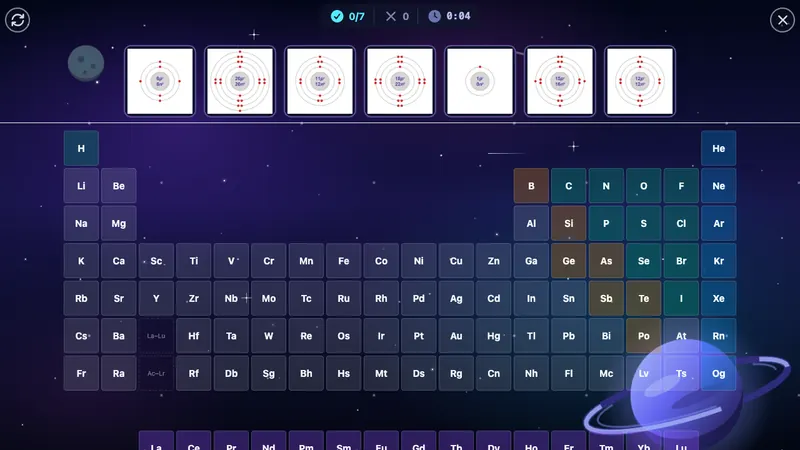
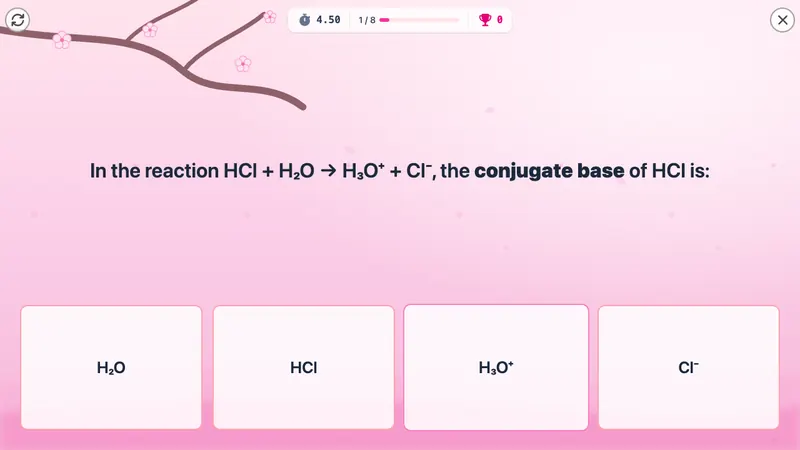
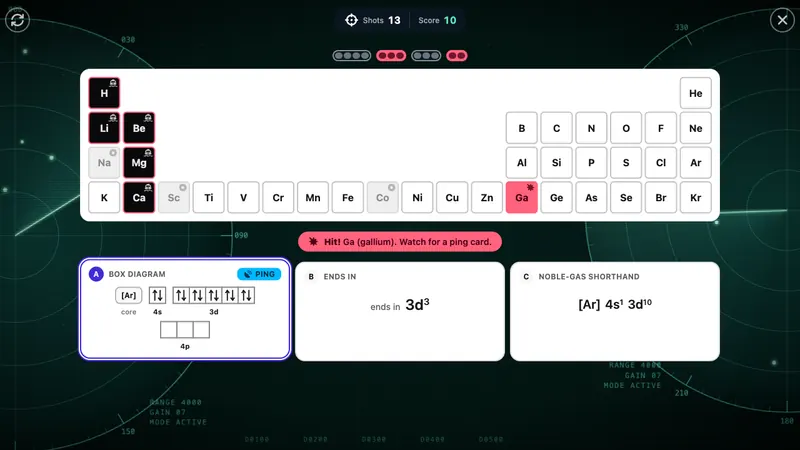
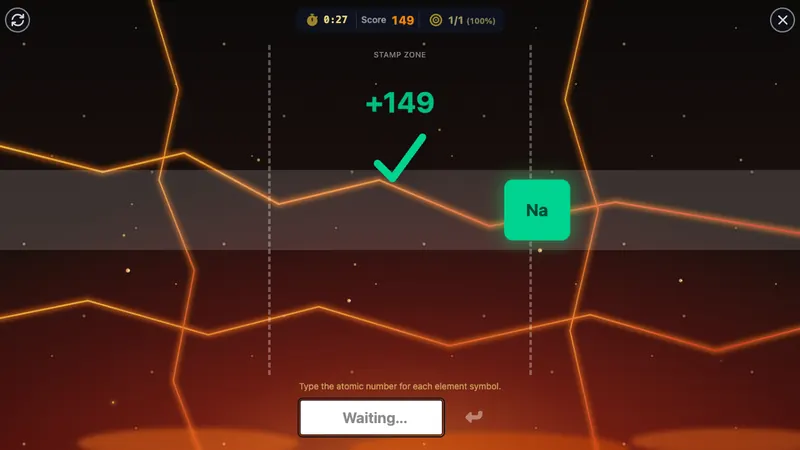
Swipe for every game · tap one to see it up close
Every game, up close
Learning disguised
as fun.
Twenty-two game types let students reinforce chemistry concepts while earning points — from fast-paced drills to Chemia, a persistent chemistry RPG. Play solo, team up in cooperative mode, or wager points in head-to-head challenges — or run any game as a Reactor, a timed sprint for the whole class. Live leaderboards keep the energy high.
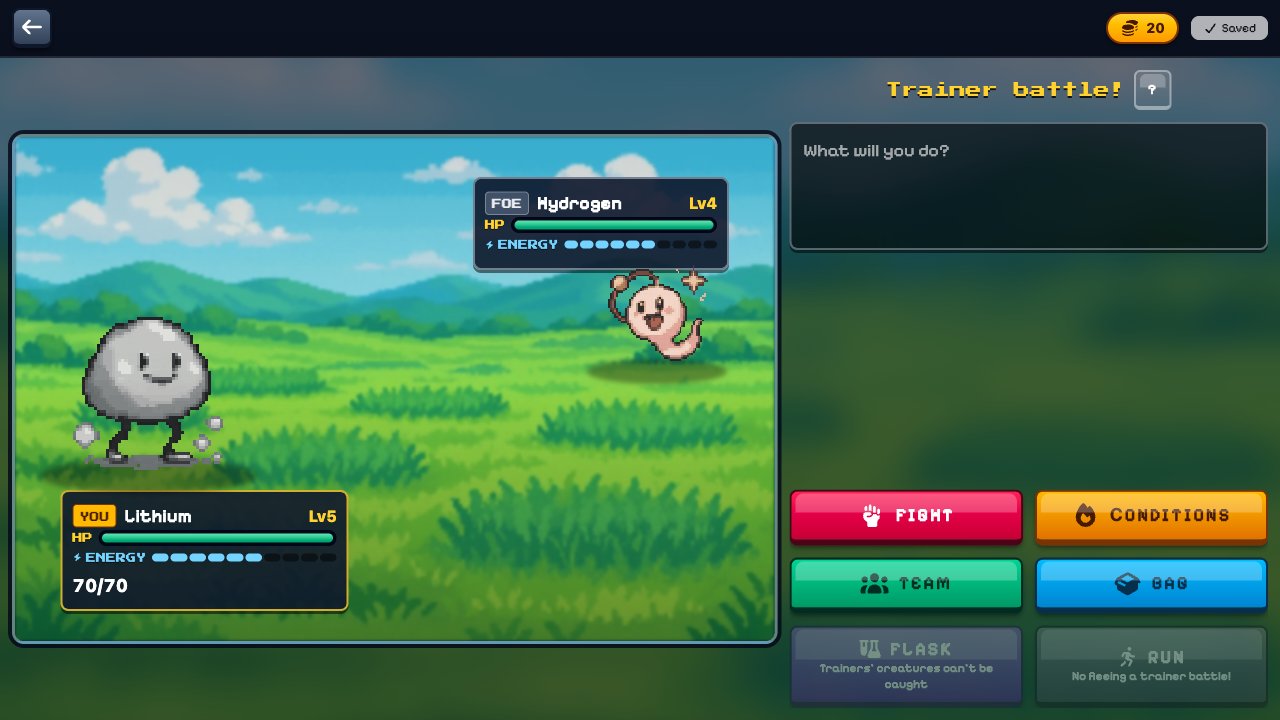
Chemia
A persistent chemistry RPG — explore the region, catch element creatures, and win battles with real reactions.
Chem Clash
A game show
where everyone wins points.
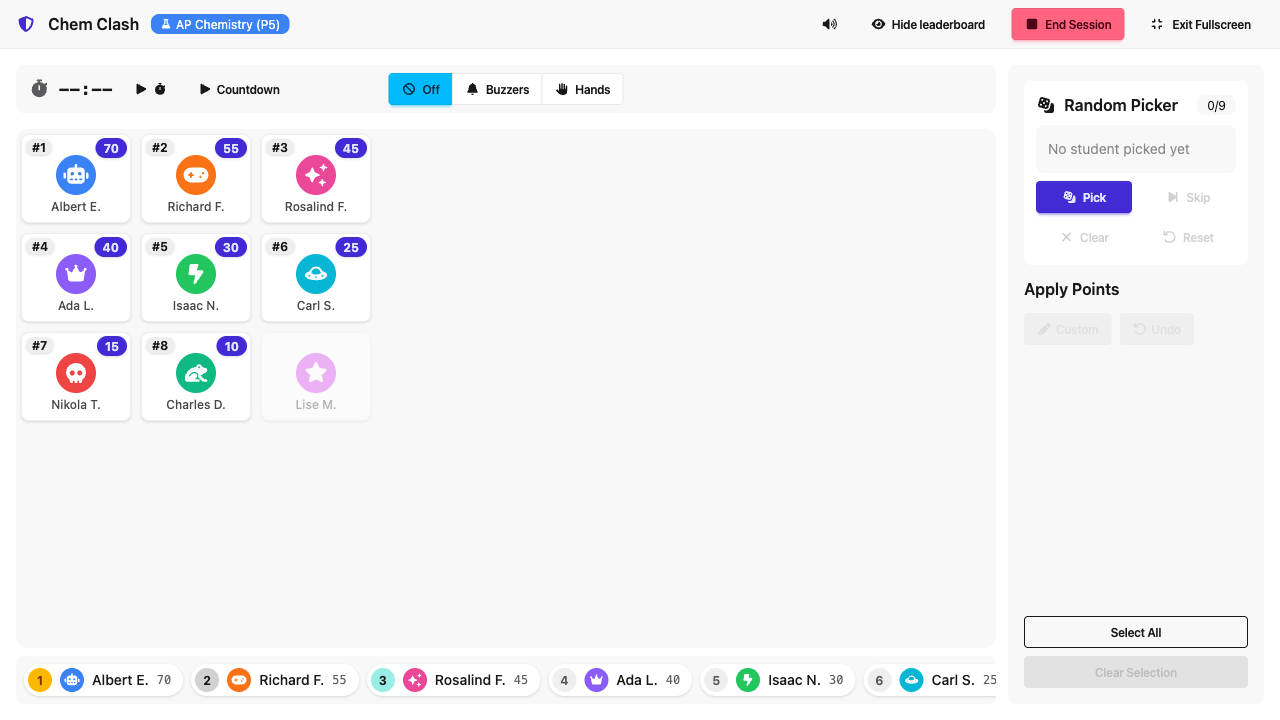
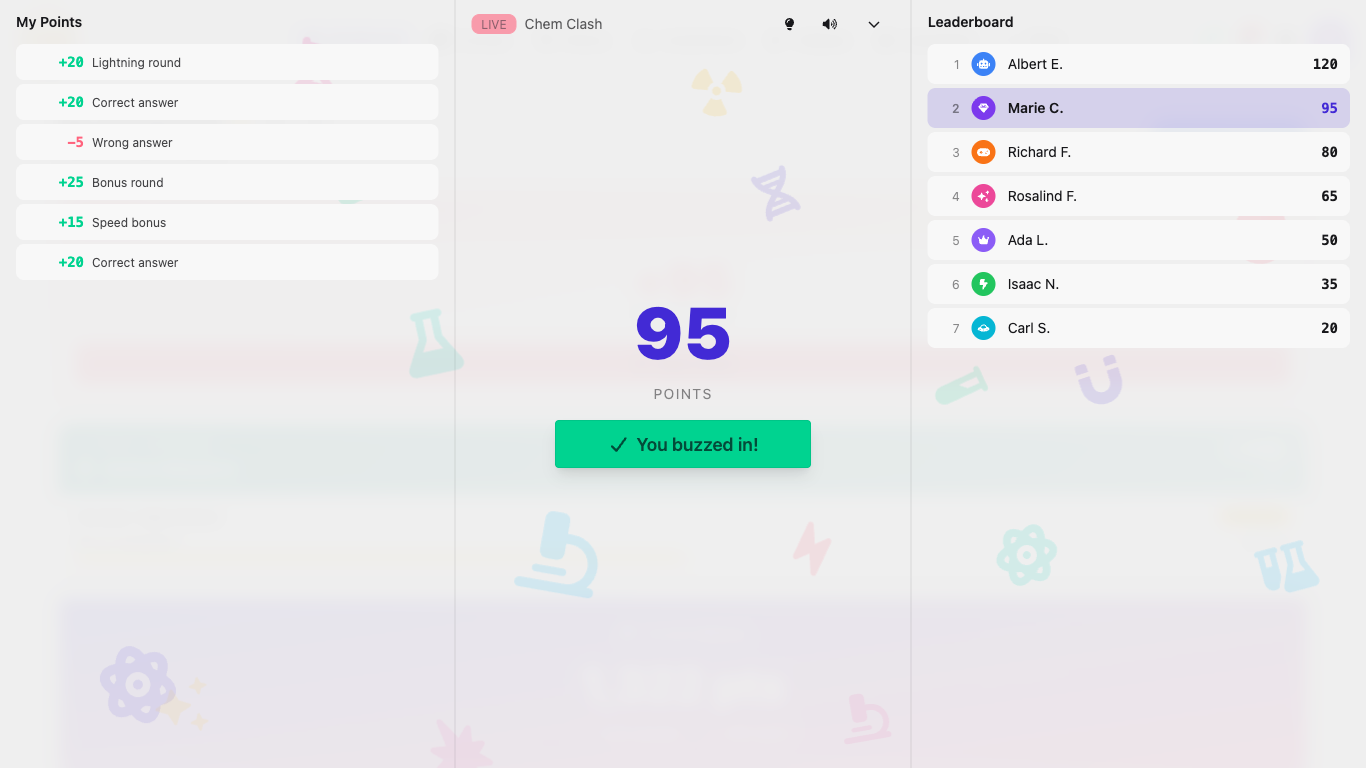
Run a live, high-energy review session. Split the class into teams or go individual. Award points on the fly as students answer — the leaderboard updates in real time on every student’s device and every point lands in their Chem Cash balance when the round ends.
- Head-to-head quiz show with live buzz-in scoring
- Individual or team mode — you choose the format
- Teacher awards or deducts points with a single tap
- Live leaderboard updates on every student's device in real time
Reactor
Any game, the whole class,
one clock.
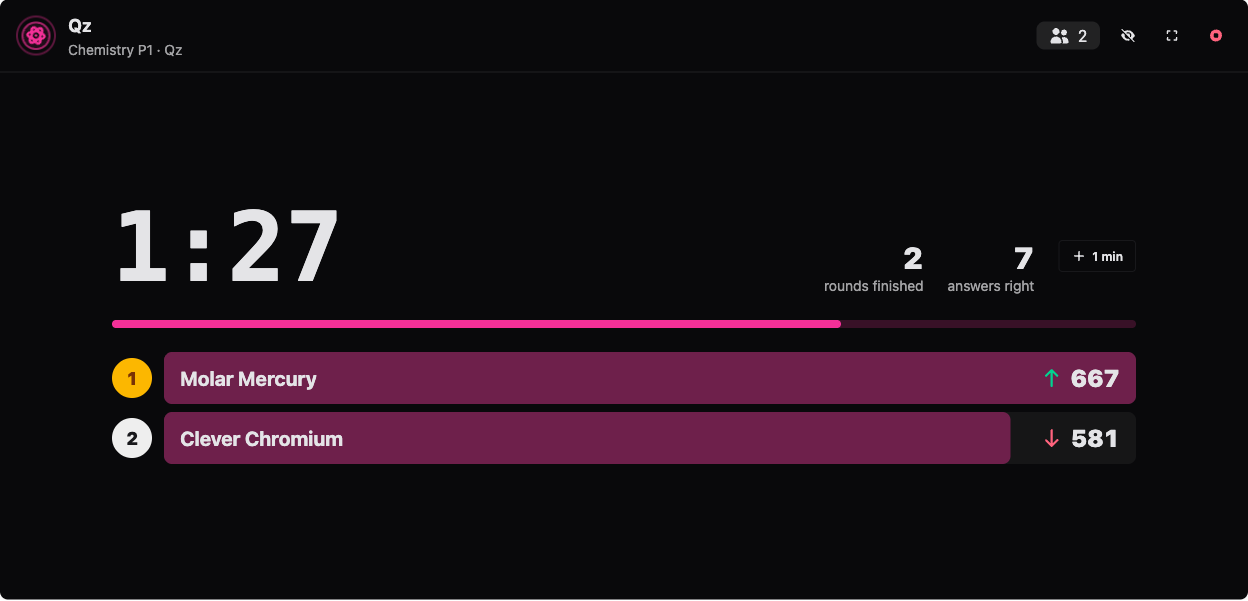
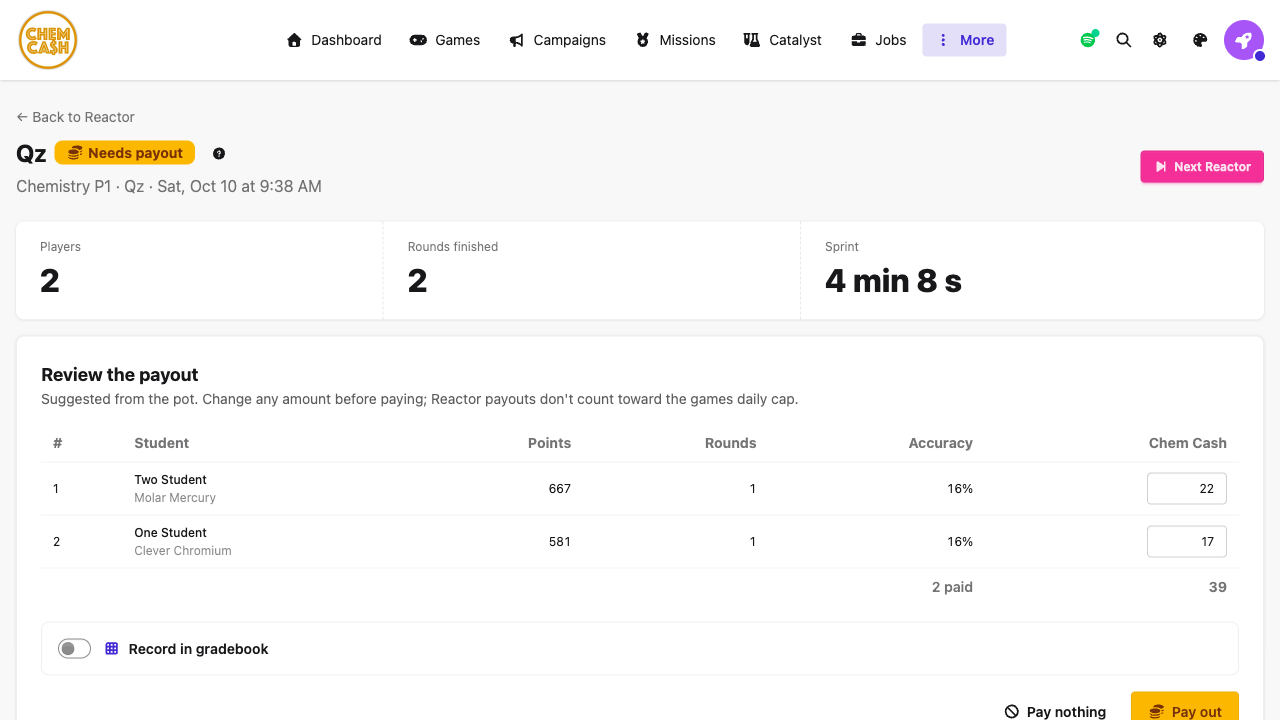
Turn any of the games into a timed class sprint. Put the board on the projector, run it from your iPad, and watch every round add up. When the clock stops, you decide who earned what.
- Pick any game, a pack and a clock — three, five, ten minutes
- Students join from their own devices and play as many rounds as they can
- The projector shows a live board by nickname, never real names
- Review every payout before it lands, and record it in the gradebook if you like
Catalyst
Ask them why.
See what stuck.
A Catalyst is one short question that asks students to explain their reasoning in their own words. Every answer is scored 0–4 against the key points you wrote, points land immediately, and the results come in live — while the class is still in the room.
Built for the ten-minute reasoning rep. A bell-ringer, an exit ticket, a check after a hard lab — never an essay.
- AI scores 0–4 against the key points you wrote — you own the rubric
- Chem Cash lands the moment it is scored, and best score pays
- Results come in live: class average, distribution, and per-period breakdown
- Try your rubric on a sample answer before you ever publish it
- Or skip the score: completion-only quick writes pay for meeting a word minimum, and AI still sums up what the class wrote
The question
Explain why an iron nail sinks in water while a wooden block floats.
What a student wrote
“Iron is denser than water so it sinks. Wood is less dense than water, so the water pushes it back up and it floats.”
Feedback the student sees
You compared both densities to water correctly. To reach a 4, say what density actually is — mass per unit volume — rather than treating it as a property you can only compare.
What the class is showing you
Confusing weight with density — many answers defined density as simply being ‘heavy’ rather than a ratio of mass to volume.~8 students
Missing the comparison to water — explained that iron is denser than wood, but never compared either to the water itself.~6 students
Try this tomorrow
Start class with two blocks of the same volume and different masses. Ask which floats, then show that density belongs to the material, not to how heavy something feels.
Lessons
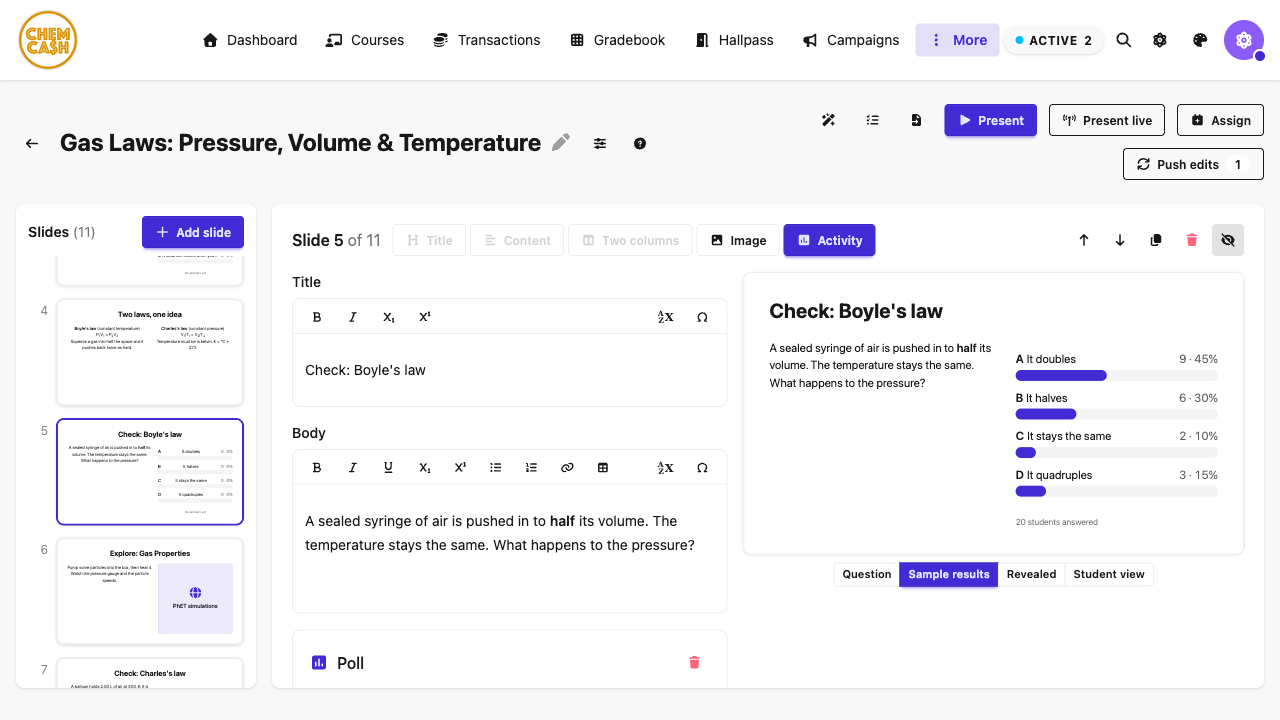
Teach your slides from Chem Cash, with polls, short answers, numbers with units, drawings and structured discussions between them. Every student answers on their own device, and a lesson that runs out of time becomes homework in one tap. Run the room from your iPad as you go: pick a student, time a task, write on a whiteboard, take raised hands or buzz-ins, and see when the class wants you to slow down. In beta.
Missions
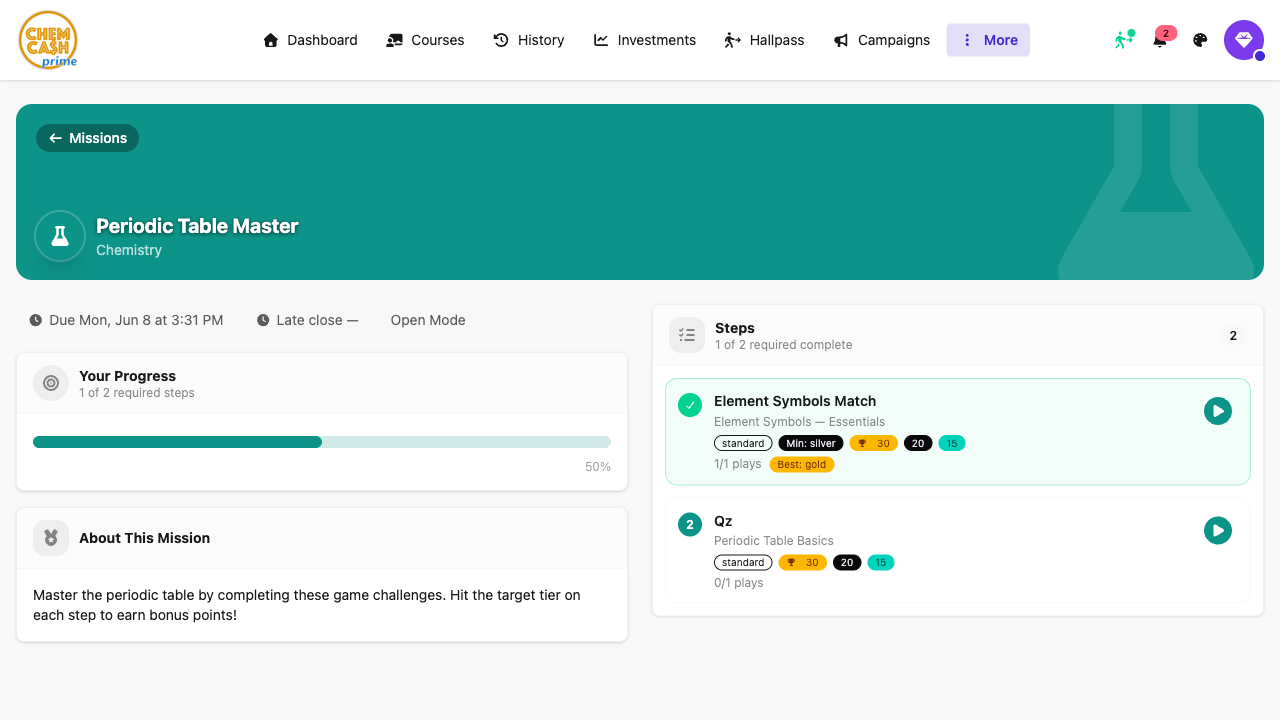
Chain game challenges into multi-step quests with bronze, silver and gold tiers, early-bird bonuses and big payouts.
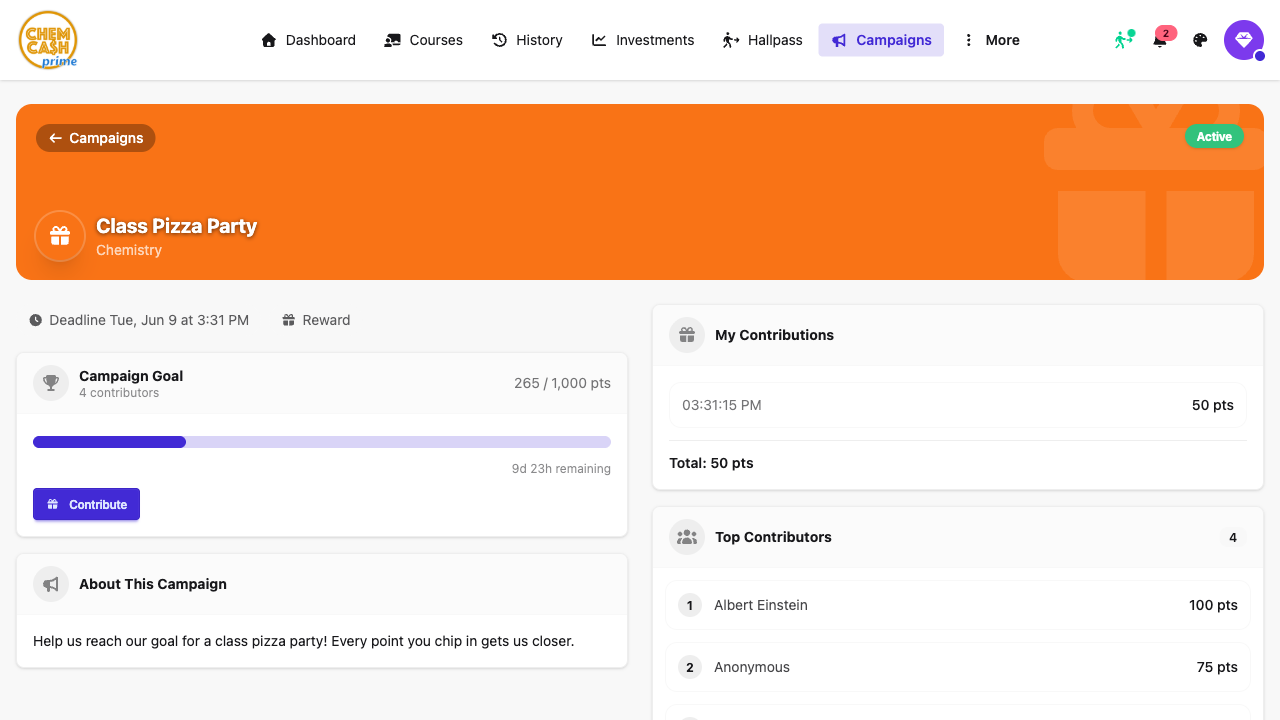
Campaigns
Pool the whole class's points toward a shared reward, with a live progress bar and a contributor leaderboard.
2 · Assess
Two ways to find out
what they know.
A quick check in the middle of the unit, and the test at the end of it, on screen or on paper. Either way, the results land in the same place.
Flashpoint
A live quiz show
that remembers.
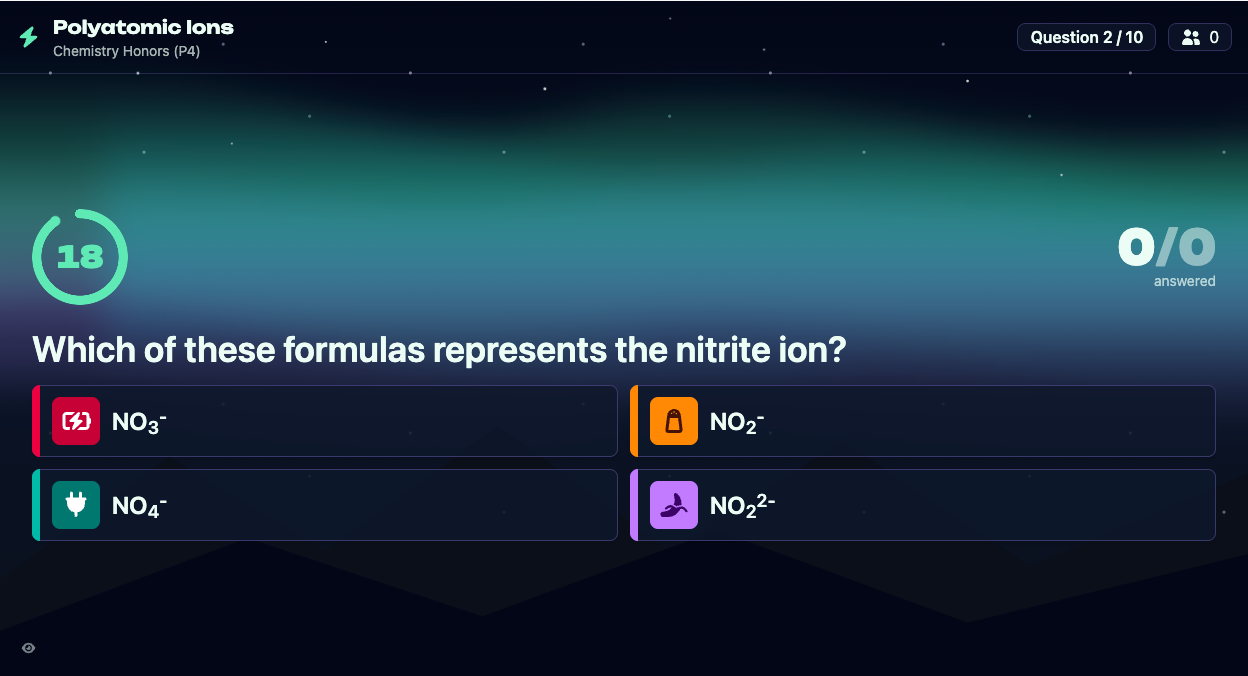
Put a question set on the board and the class answers from their devices, or send it home as self-paced practice. Either way, students earn points, and every answer tells you something about the topic it was tagged with.
- Host it live on the projector, or assign it to do at their own pace
- Multiple choice, numbers with sig figs, typed answers, ordering and matching
- Write your own questions, or have AI draft a set — even from a worksheet you upload
- Run it as an assessment: lockdown, a proctor view, timed attempts and extended time
- Results pay points, and every answer lands in Understanding
AssayAI grading in pilot
Grade the stack
in minutes.
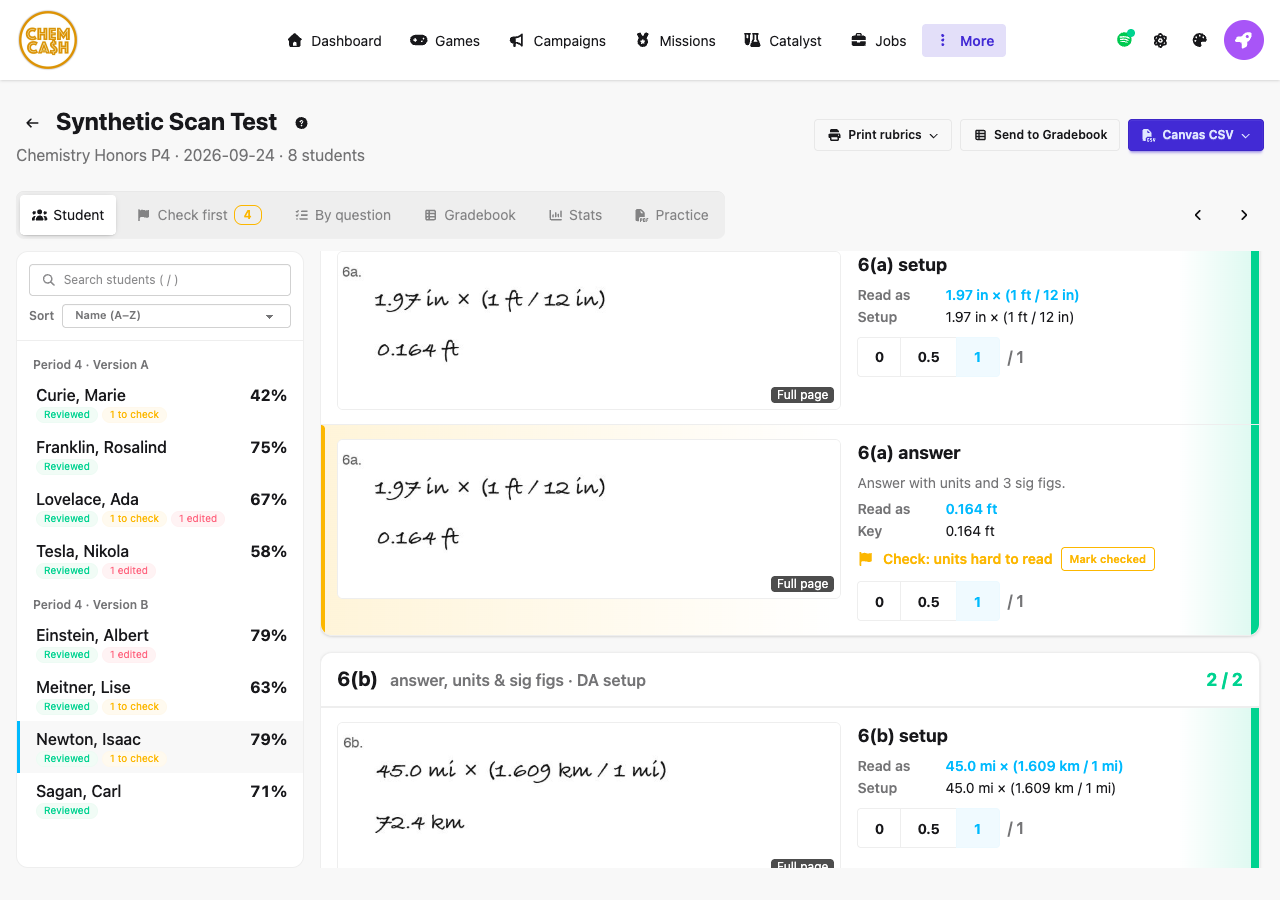
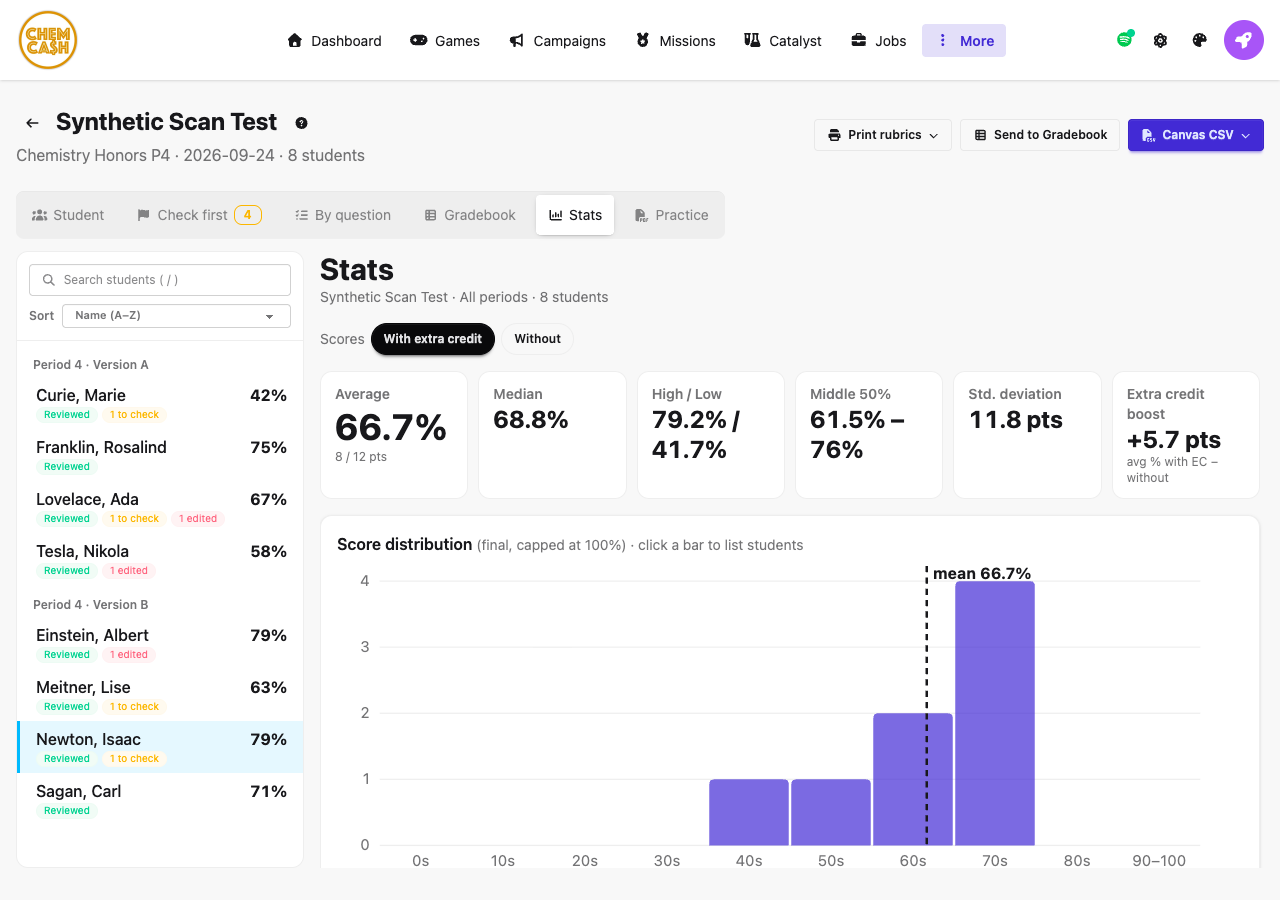
AI reads every handwritten answer and scores it item by item. You don’t re-grade the stack: you review what it flagged, change anything you disagree with, and the scores are yours.
- Scan a class set of handwritten tests; AI scores every answer against your rubric
- It writes down what it read and flags what it isn't sure of, so you check only those
- Print a rubric with feedback for every student, and see the class stats
- Share it, and each student sees their own scores, a note on every item they missed, and retake practice
- Send the scores to your gradebook; tag the test by topic and it counts toward Understanding
2.4%
of AI scores changed on review
36 of 1,512 item scores, across 63 handwritten unit tests.
4 hrs → 25 min
per class set of tests
Grading by hand, vs. reviewing in Assay.
A unit test given in September 2026, reviewed in Assay by the teacher who gave it. The screens above show a synthetic test class.
Built in a chemistry classroom, but Assay, Flashpoint and Understanding work for any subject.
3 · Understand
What every class
actually understands.
Understanding puts together what Chem Cash already sees (tagged test scores, Catalyst explanations, Flashpoint rounds and game play) into one estimate per topic, with how much evidence backs it. It’s not a grade. It’s where to spend tomorrow.
- Sixteen chemistry topics, one row each, for every class
- Confidence shows how much evidence stands behind each estimate
- A next move for every topic: ready to move on, revisit, or gather evidence
- Students see their own topics too, framed as "not a grade"
Chemistry · Period 2
Ready when the class is at 70%
Matter & Measurement
2 summatives · 4 Flashpoint rounds · 9 game days
84%
Confident82%
Ready to move onAtomic Structure
1 summative · 2 Catalysts · 7 game days
76%
Confident71%
Ready to move onChemical Bonding
1 Catalyst · 3 Flashpoint rounds · 5 game days
52%
Emerging54%
RevisitPeriodic Table & Trends
2 Flashpoint rounds · 6 game days
63%
Emerging46%
RevisitThe Mole & Stoichiometry
1 game day
Not enough evidence yet
Limited12%
—Gather evidence
Chemistry · Period 2
Chemical Bonding
Assay
Print retake practice, or share it online with the students who missed it
Flashpoint
Assign a self-paced set on the topic
Missions
Post a mission: three rounds of Lewis Lab
Catalyst
Ask one question: explain it in your own words
4 · Reteach
Reteach before the test, not after it.
When a topic comes up revisit, the next move is already in the same app: retake practice for the students who need it, a Flashpoint set, a mission or one Catalyst question. The ones students do in Chem Cash pay points, so the reps don’t stop, and the loop starts again.
Running the room
Everything else you need.
The day-to-day classroom utilities that round out Chem Cash — from the first bell to the last. Press ⌘K anywhere to jump straight to any of them.
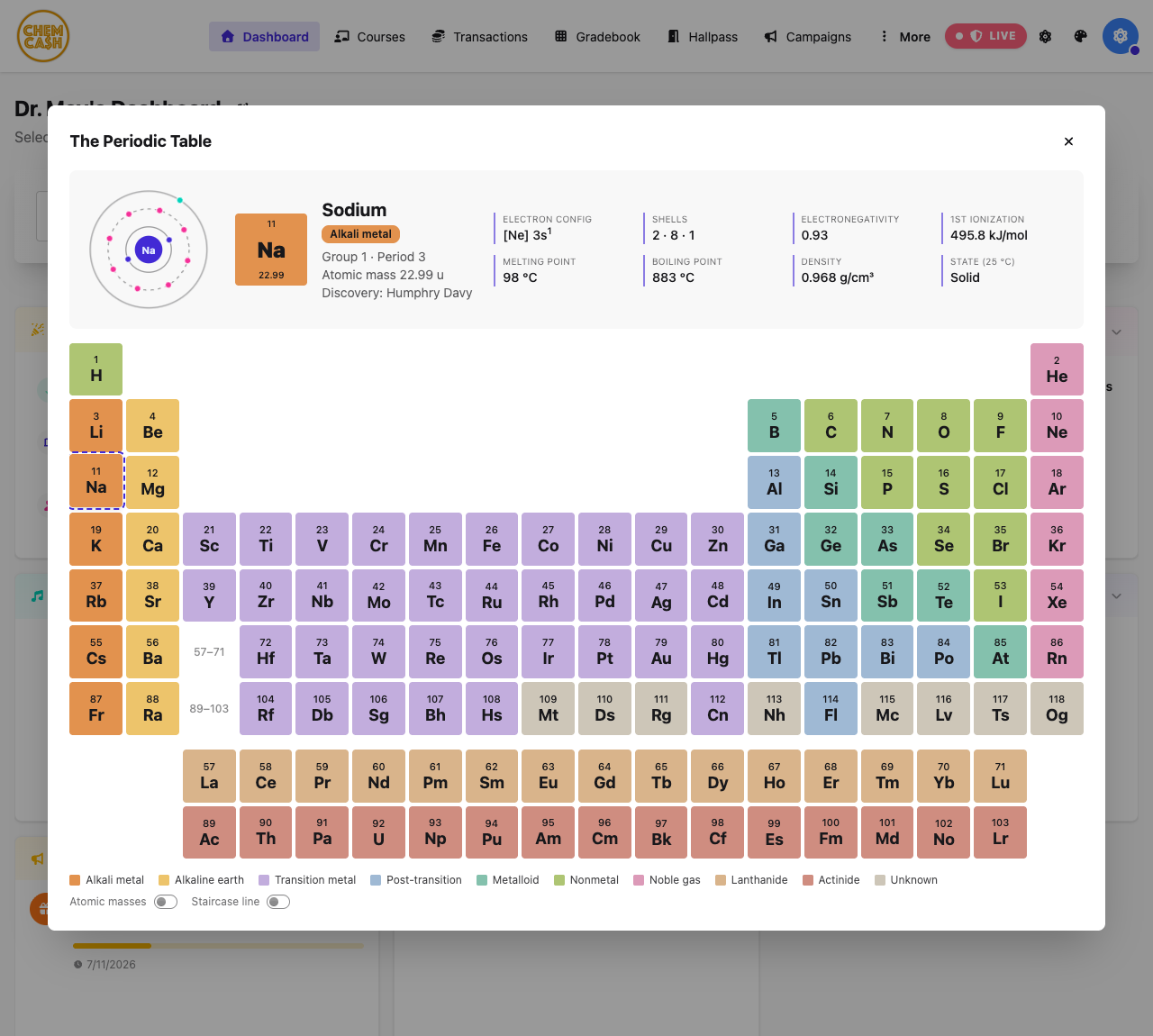
Periodic Table
Every element.
One click away.
An interactive periodic table lives in the top bar for teachers and students alike. Click any element for its full detail card — complete with a live animated Bohr model, just like the one spinning here.
- All 118 elements — electron configurations, trends, and key data
- Animated Bohr models bring atomic structure to life
- Spotlight element families and walk the grid with arrow keys
- Open during Chem Clash sessions — but blocked during games for points
Hydrogen1
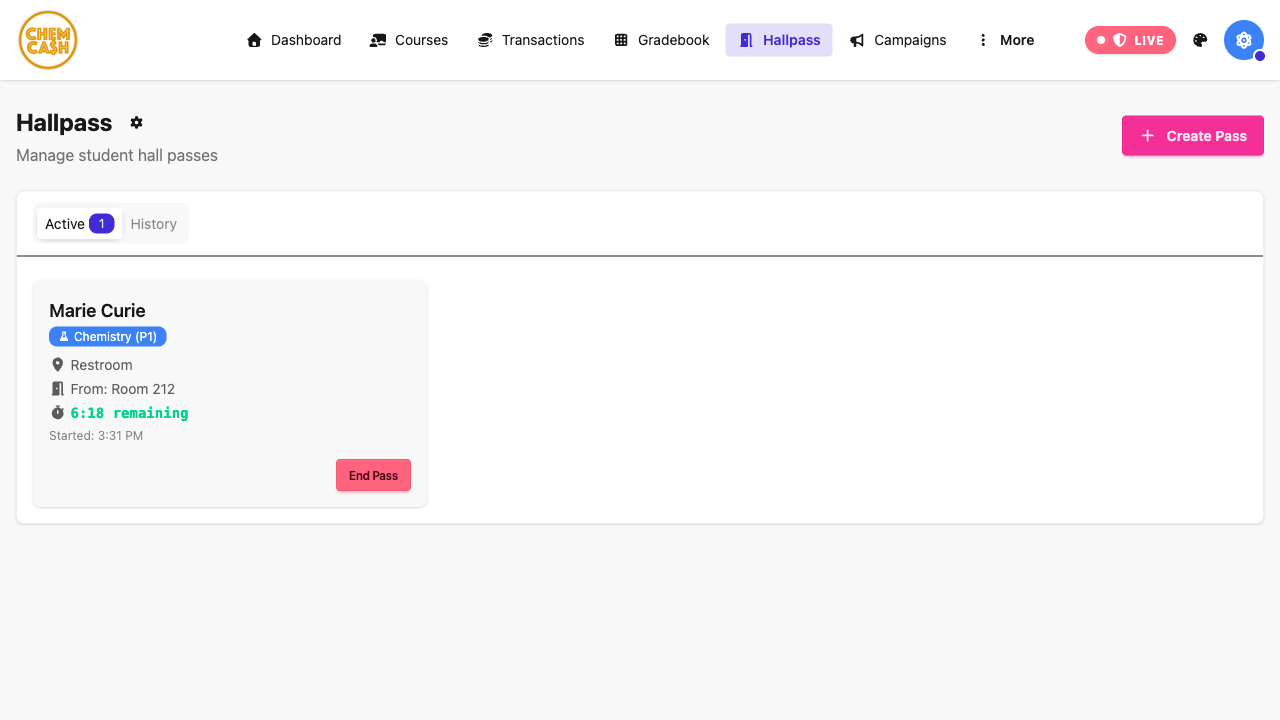
Digital Hall Pass
Timed passes with a fullscreen countdown display. Optionally charge students points to request one — making passes a spending decision. Track who's out in real time and keep a full log.
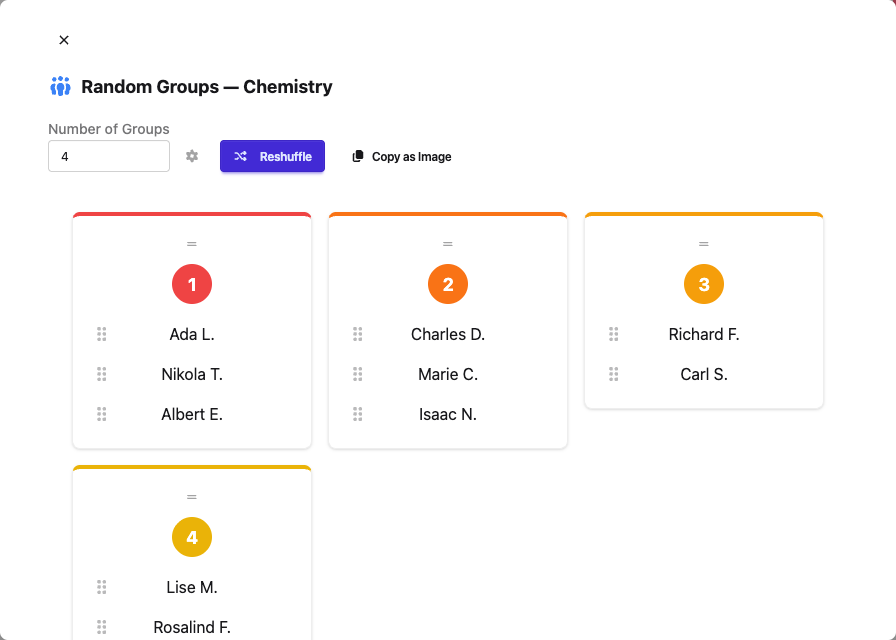
Random Picker & Groups
Call on a student at random from the dashboard, or shuffle your whole class into balanced groups in one click — then drag to fine-tune. Goodbye, popsicle sticks.
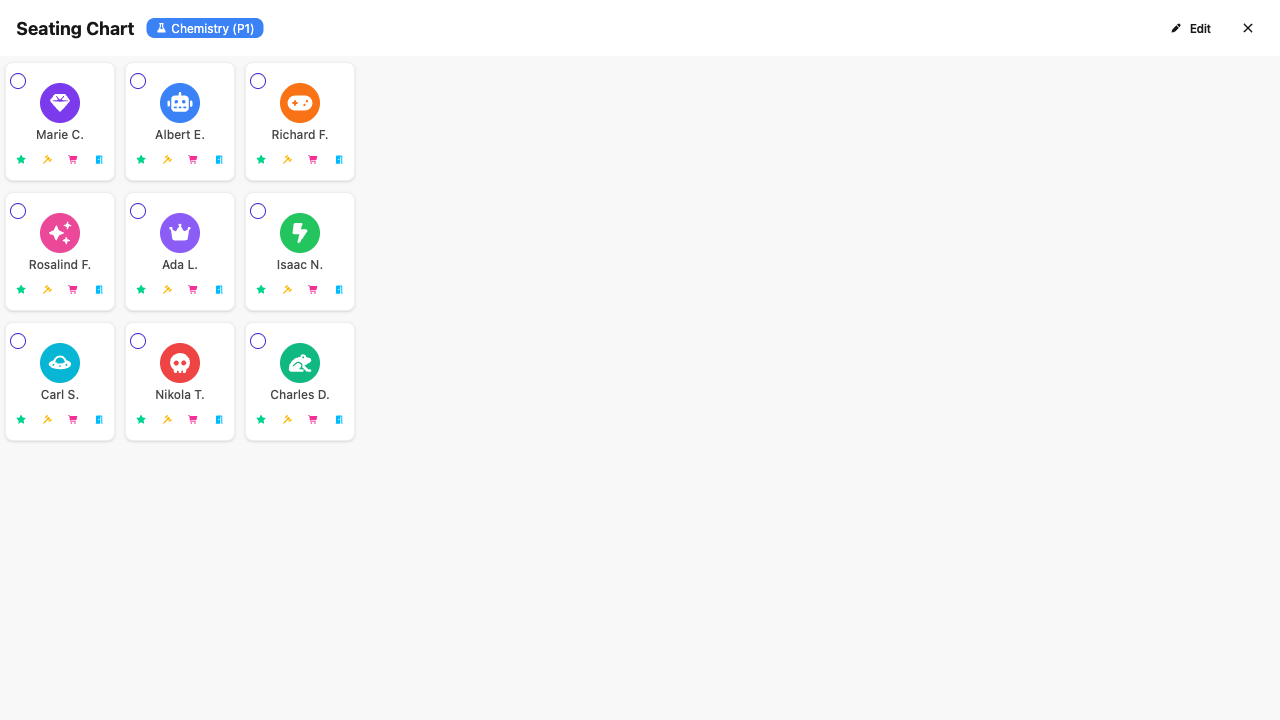
Seating Charts
Pull up your seating chart and award bonuses or post fines right from a student's seat. Select a whole table to reward — or fine — the group in one tap.
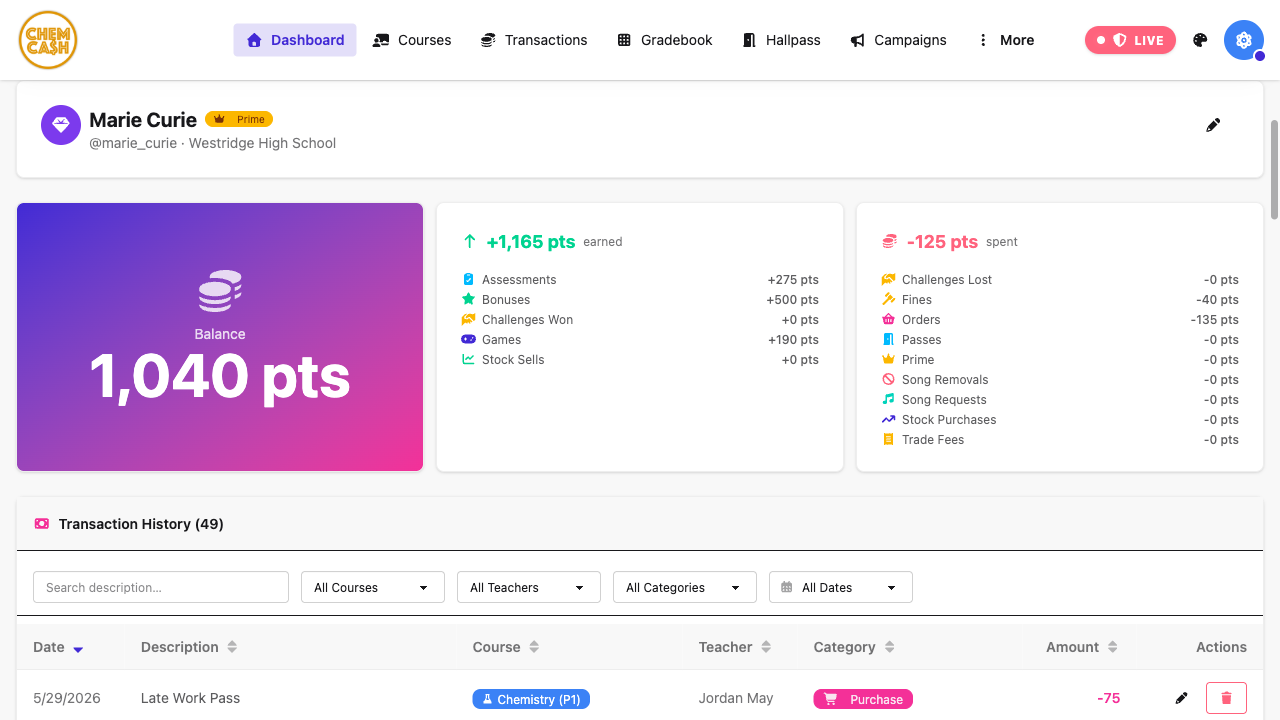
Student Profiles
Pull up any student to see their balance, transaction history, jobs, missions, and investments at a glance — then award or adjust points on the spot.
What’s inside
- chemistry games
- 22chemistry games
- content packs
- 178content packs
- chemistry topics tracked
- 16chemistry topics tracked
- help articles
- 160+help articles
- automated tests
- 10,000+automated tests

"I built Chem Cash because I wanted my students to feel like they were working toward something real — and because I wanted to spend less time on logistics and more time on teaching."
Joseph W. May, Ph.D. · “Doc May”
High school chemistry teacher since 2014 · Teach For America, Las Vegas Valley
Hi! I'm Joseph May. I'm a Ph.D. computational chemist (University of Washington) turned Teach For America corps member (Las Vegas Valley, 2014), and I've taught high school chemistry ever since. I also love building for the web, so why not combine the two.
Chem Cash began as a points-based rewards system for my classroom. The idea for this site came from a colleague who was inspired by one of his own high school science teachers.
Students earn points in two ways: (1) through payouts based on their assessment scores and (2) with bonus points earned for anything I deem worthy of reward such as winning in-class competitions or going above and beyond to help me or a fellow student.
These points can be used to “purchase” goods such as school supplies, electronics, and anything I can find for cheap or get for free.
However, the hottest-selling item is song requests. During work time in my class I play music for my students. Each class period has its own playlist and students can only add songs to the playlist by spending their Chem Cash points.
What started as a way to manage the logistics behind my own classroom has become the place I run it: the class economy, the games and quizzes, grading the tests, and seeing what every class understands. I teach a full load and build Chem Cash alongside it, with pilot teachers testing it in their classrooms every day. A student reports a bug on Monday; the fix ships that week. If you'd like to bring Chem Cash to your classroom, I'd love to hear from you.
Chem Cash is part of a small ecosystem I build for chemistry teachers and students: chemlessons.xyz is my free chemistry curriculum companion site, and docmayscience.com is more about me.
Chem Cash is a modern, real-time web app built end to end on a fully typed stack — a React front end, a Convex backend for live data, and Clerk for secure sign-in, all shipped on Vercel.
React
React Router
TypeScript
Tailwind CSS
Convex
Clerk
Vite
Vercel
Built with a little help
I build alongside AI pair-programming tools — they help me ship faster and keep the codebase clean.
Claude Code
AI pair programmer
VS Code
Code editor
GitHub Copilot
In-editor AI
Ready to transform
your classroom?
Bring the class economy, and everything it now runs, to your room. Chem Cash is free for pilot teachers this school year — join the pilot and we’ll help get you set up.
Works on any device · Live in minutes · Nothing to install